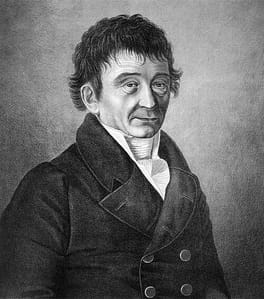
Photo: Ludwig Albert von Montmorillon / Public domain (source: Wikimedia Commons)
Ernst Chladni, born on November 30, 1756 in Lutherstadt Wittenberg, Saxony-Anhalt, Germany, was a physicist, astronomer and mathematician. Death is recorded on April 3, 1827, at the age of 70. Ernst Chladni was educated at Leipzig University.
My Take
Chladni is the rare figure who lived where science and art blur, and that is exactly why I find him so compelling. His sand-on-vibrating-plate patterns made the invisible architecture of sound suddenly visible, an image so beautiful it still gets recreated in classrooms and art installations centuries later. He earned the title father of acoustics, but he roamed freely across astronomy, mathematics, and even argued that meteorites came from space when that idea sounded absurd. I love that kind of mind, one driven by curiosity rather than discipline boundaries. He proved that careful measurement and genuine wonder are not opposites but partners.
This take was written by generative AI, one per person, from publicly reported facts (editorial policy). It is a reading of the record, not reporting.
1. Profile
- Name (English)
- Ernst Chladni
- Name (Japanese)
- エルンスト・クラドニ
- Reading
- えるんすと・くらどに
- Born
- November 30, 1756 – April 3, 1827
- Origin
- Lutherstadt Wittenberg, Saxony-Anhalt, Germany
- Occupation
- physicist / astronomer / mathematician / musician / geologist
- Zodiac / Chinese zodiac
- Sagittarius / Rat
2. Background
- University
- Leipzig University
3. Links
4. About this entry
Tags
- Last updated
Facts are limited to publicly available information up to 2024; non-public or unconfirmed items are omitted. English text is machine-assisted (facts translated by Sonnet, "My Take" written by Opus 4.8). The Japanese page is the source of record.
Frequently asked questions
When was Ernst Chladni born?
Born November 30, 1756.
When did Ernst Chladni die?
Died April 3, 1827, aged 70.
Where was Ernst Chladni from?
Ernst Chladni was from Lutherstadt Wittenberg, Saxony-Anhalt, Germany.
What did Ernst Chladni do?
Ernst Chladni worked as physicist, astronomer, mathematician, musician, geologist.
Physicist — see all → · Astronomer — see all → · More people from Germany →