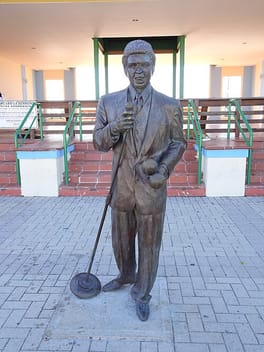
Photo: Tito Caraballo / CC BY-SA 2.0 (source: Wikimedia Commons)
Public records list Héctor Lavoe as a singer, composer and record producer. Héctor Lavoe was born on September 30, 1946 in Ponce, United States. Death is recorded on June 29, 1993, at the age of 46. The listed height was 173 cm.
My Take
To me, Héctor Lavoe simply is salsa's beating heart. Born in Ponce, Puerto Rico, he was central to pushing the genre across the globe through the '60s, '70s, and '80s, and that voice, conversational yet soaring, still raises the hair on my arms. He wrote, produced, and sang, a complete artist, which makes losing him at 47 sting all the more. His was a life of bright peaks and deep shadows, and you can hear every bit of that chiaroscuro bleeding into the music. The fact that his name surfaces every single time salsa is discussed is the surest proof of a true legend.
This take was written by generative AI, one per person, from publicly reported facts (editorial policy). It is a reading of the record, not reporting.
1. Profile
- Name (English)
- Héctor Lavoe
- Name (Japanese)
- エクトル・ラボー
- Reading
- えくとる・らぼー
- Born
- September 30, 1946 – June 29, 1993
- Origin
- Ponce, United States
- Height
- 173 cm
- Occupation
- singer / composer / record producer / musician / songwriter
- Zodiac / Chinese zodiac
- Libra / Dog
2. Links
- Official sitehttps://www.hectorlavoe.com/
- Wikipedia (English)https://en.wikipedia.org/wiki/H%C3%A9ctor%20Lavoe
- Wikipedia (Japanese)https://ja.wikipedia.org/wiki/%E3%82%A8%E3%82%AF%E3%83%88%E3%83%AB%E3%83%BB%E3%83%A9%E3%83%9C%E3%83%BC
- Wikidatahttps://www.wikidata.org/wiki/Q555195
3. About this entry
Tags
- Last updated
Facts are limited to publicly available information up to 2024; non-public or unconfirmed items are omitted. English text is machine-assisted (facts translated by Sonnet, "My Take" written by Opus 4.8). The Japanese page is the source of record.
Frequently asked questions
When was Héctor Lavoe born?
Born September 30, 1946.
When did Héctor Lavoe die?
Died June 29, 1993, aged 46.
Where was Héctor Lavoe from?
Héctor Lavoe was from Ponce, United States.
What did Héctor Lavoe do?
Héctor Lavoe worked as singer, composer, record producer, musician, songwriter.
How tall was Héctor Lavoe?
Héctor Lavoe was 173 cm.
Singer — see all → · Composer — see all → · More people from the United States →