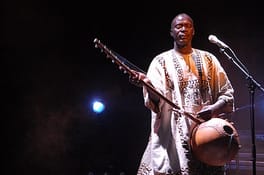
Photo: MBGUEY / CC BY-SA 4.0 (source: Wikimedia Commons)
Issa Bagayogo was listed as a musician and singer. Issa Bagayogo died on October 10, 2016.
My Take
Issa Bagayogo is the kind of artist I keep returning to. There's something quietly radical about fusing the ancient kamele n'goni with Yves Wernert's electronic production, and Bagayogo pulled it off without ever sounding gimmicky. To me his voice carried real devotion, grounding all the synthetic textures in something deeply human. Four albums isn't a huge catalogue, but each one feels considered rather than churned out. His death in 2016 cut short a sound that bridged tradition and the dancefloor, and I think his understated, rooted style deserves far more listeners than it ever got.
This take was written by generative AI, one per person, from publicly reported facts (editorial policy). It is a reading of the record, not reporting.
1. Profile
- Name (English)
- Issa Bagayogo
- Name (Japanese)
- イサ・バガヨゴ
- Reading
- いさ・ばがよご
- Born
- 1961 – October 10, 2016
- Origin
- Mali
- Occupation
- musician / singer
- Zodiac / Chinese zodiac
- Ox
2. Links
- Wikipedia (English)https://en.wikipedia.org/wiki/Issa%20Bagayogo
- Wikipedia (Japanese)https://ja.wikipedia.org/wiki/%E3%82%A4%E3%82%B5%E3%83%BB%E3%83%90%E3%82%AC%E3%83%A8%E3%82%B4
- Wikidatahttps://www.wikidata.org/wiki/Q1123105
3. About this entry
Tags
- Last updated
Facts are limited to publicly available information up to 2024; non-public or unconfirmed items are omitted. English text is machine-assisted (facts translated by Sonnet, "My Take" written by Opus 4.8). The Japanese page is the source of record.
Frequently asked questions
Where was Issa Bagayogo from?
Issa Bagayogo was from Mali.
What did Issa Bagayogo do?
Issa Bagayogo worked as musician, singer.
Musician — see all → · Singer — see all → · More people from Mali →