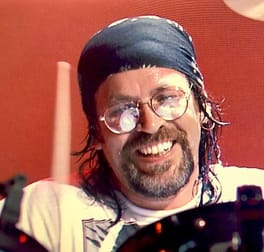
Photo: Oliver"DrumDoc"Knieps / CC BY-SA 4.0 (source: Wikimedia Commons)
Born on April 1, 1954 in Hartford, Connecticut, United States, Jeff Porcaro was a drummer, jazz musician and songwriter. Jeff Porcaro died on August 5, 1992, aged 38. Education on record includes Grant High School.
My Take
Honestly, Jeff Porcaro might be the most important drummer most casual music fans have never consciously noticed — and that invisibility was kind of his superpower. He co-founded Toto and gave the world that iconic half-time shuffle on "Rosanna," a groove so perfect that drum instructors still use it as a case study decades later. But beyond Toto, the man was a session legend who played on hundreds of records — Boz Scaggs, Michael Jackson's "Thriller," Elton John, Paul McCartney — quietly holding the pocket while everyone else got the credit. He never overplayed, never showboated, just laid down exactly what the song needed with this warm, earthy feel that's genuinely hard to teach. Losing him at 38 in 1992 was a gut punch to everyone who knew what they were hearing, and the older I get, the more I realize how much his restraint was actually the whole thing.
This take was written by generative AI, one per person, from publicly reported facts (editorial policy). It is a reading of the record, not reporting.
1. Profile
- Name (English)
- Jeff Porcaro
- Name (Japanese)
- ジェフ・ポーカロ
- Reading
- じぇふ・ぽーかろ
- Born
- April 1, 1954 – August 5, 1992
- Origin
- Hartford, Connecticut, United States
- Occupation
- drummer / jazz musician / songwriter / session musician / musician
- Zodiac / Chinese zodiac
- Aries / Horse
2. Background
- High school
- Grant High School
3. Links
- Wikipedia (English)https://en.wikipedia.org/wiki/Jeff%20Porcaro
- Wikipedia (Japanese)https://ja.wikipedia.org/wiki/%E3%82%B8%E3%82%A7%E3%83%95%E3%83%BB%E3%83%9D%E3%83%BC%E3%82%AB%E3%83%AD
- Wikidatahttps://www.wikidata.org/wiki/Q350353
4. About this entry
Tags
- Last updated
Only publicly available facts are listed; non-public or unconfirmed items are omitted. Base data was compiled from Wikidata from June 2026 onward; ages are recalculated daily and deaths are checked against Wikidata on an ongoing basis. English text is machine-assisted (facts translated by Sonnet, "My Take" written by Opus 4.8). The Japanese page is the source of record.
Frequently asked questions
When was Jeff Porcaro born?
Jeff Porcaro was born on April 1, 1954.
When did Jeff Porcaro die?
Jeff Porcaro died on August 5, 1992, aged 38.
Where was Jeff Porcaro from?
Jeff Porcaro was from Hartford, Connecticut, United States.
What did Jeff Porcaro do?
Jeff Porcaro worked as drummer, jazz musician, songwriter, session musician, musician.
Which high school did Jeff Porcaro attend?
Jeff Porcaro attended Grant High School.
Drummer — see all → · Jazz musician — see all → · More people from the United States → · More people born on April 1 →