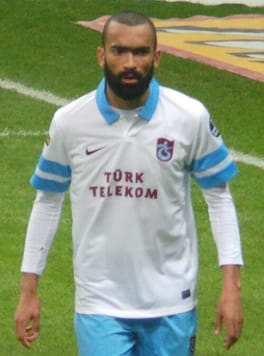
Photo: Ultraslansi / CC BY-SA 3.0 (source: Wikimedia Commons)
José Bosingwa was born on August 24, 1982 in Mbandaka, Équateur, Democratic Republic of the Congo. José Bosingwa is listed as an association football player. That works out to 44 years old in 2026. The listed height is 183 cm.
My Take
José Bosingwa is the kind of full-back I always enjoyed watching, the marauding right-back who treated defending as an afterthought to attacking. What fascinates me most is his collection: 13 major honours, including the rare feat of winning the Champions League with two different clubs, Porto in 2004 and Chelsea in 2012. Born in Mbandaka in what was then Zaire, he carved out a career that spanned Boavista, Porto and the Premier League's most demanding stage. At 183 cm he had the engine to bomb up and down the flank. To me he embodies that golden Porto-to-Chelsea pipeline of the late 2000s.
This take was written by generative AI, one per person, from publicly reported facts (editorial policy). It is a reading of the record, not reporting.
1. Profile
- Name (English)
- José Bosingwa
- Name (Japanese)
- ジョゼ・ボシングワ
- Reading
- じょぜ・ぼしんぐわ
- Born
- August 24, 1982 (age 44)
- Origin
- Mbandaka, Équateur, Democratic Republic of the Congo
- Height
- 183 cm
- Occupation
- association football player
- Zodiac / Chinese zodiac
- Virgo / Dog
2. Links
3. About this entry
Tags
- Last updated
Facts are limited to publicly available information up to 2024; non-public or unconfirmed items are omitted. English text is machine-assisted (facts translated by Sonnet, "My Take" written by Opus 4.8). The Japanese page is the source of record.
Frequently asked questions
When was José Bosingwa born?
Born August 24, 1982 (age 44).
Where is José Bosingwa from?
José Bosingwa is from Mbandaka, Équateur, Democratic Republic of the Congo.
What does José Bosingwa do?
José Bosingwa works as association football player.
How tall is José Bosingwa?
José Bosingwa is 183 cm.
Association football player — see all → · More people from the Democratic Republic of the Congo →