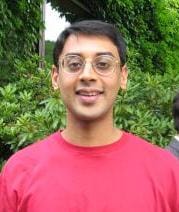
Photo: Schmid, Renate / CC BY-SA 2.0 de (source: Wikimedia Commons)
Manjul Bhargava was born on August 8, 1974 in Hamilton, Ontario, Canada and is credited as a mathematician and university teacher. Manjul Bhargava is 52 years old as of 2026. Schooling on record includes Plainedge High School and Harvard University. Recorded honors include Fields medal (2014), Blumenthal Award (2005), Cole Prize in Number Theory (2008) and 5 more.
My Take
Manjul Bhargava is, simply put, a superstar of mathematics. Winning the 2014 Fields Medal, the discipline's highest honor, alongside the Cole, Fermat, and Infosys prizes, places him among the great minds of his generation. I cannot follow his number theory, but I am moved by the idea that someone can construct entire universes inside their head and shed new light on classical mathematics. That he also plays the tabla tells me he hears beauty in both proofs and rhythm. To me he embodies a rare, luminous intelligence, the kind that quietly reshapes how we understand numbers.
This take was written by generative AI, one per person, from publicly reported facts (editorial policy). It is a reading of the record, not reporting.
1. Profile
- Name (English)
- Manjul Bhargava
- Name (Japanese)
- マンジュル・バルガヴァ
- Reading
- まんじゅる・ばるがゔぁ
- Born
- August 8, 1974 (age 52)
- Origin
- Hamilton, Ontario, Canada
- Occupation
- mathematician / university teacher
- Zodiac / Chinese zodiac
- Leo / Tiger
2. Background
- High school
- Plainedge High School
- University
- Harvard University
Awards & achievements
- 2014 Fields medal
- 2005 Blumenthal Award
- 2008 Cole Prize in Number Theory
- 2011 Fermat Prize
- 2015 Padma Bhushan in science & engineering
- 2012 Infosys Prize
- 2013 Fellow of the American Mathematical Society
- Clay Research Award
3. Links
4. About this entry
Tags
- Last updated
Facts are limited to publicly available information up to 2024; non-public or unconfirmed items are omitted. English text is machine-assisted (facts translated by Sonnet, "My Take" written by Opus 4.8). The Japanese page is the source of record.
Frequently asked questions
When was Manjul Bhargava born?
Manjul Bhargava was born on August 8, 1974 and is 52 years old.
Where is Manjul Bhargava from?
Manjul Bhargava is from Hamilton, Ontario, Canada.
What does Manjul Bhargava do?
Manjul Bhargava works as mathematician, university teacher.
Where did Manjul Bhargava study?
Manjul Bhargava attended Harvard University.
Mathematician — see all → · University teacher — see all → · More people from Canada → · More people born on August 8 →