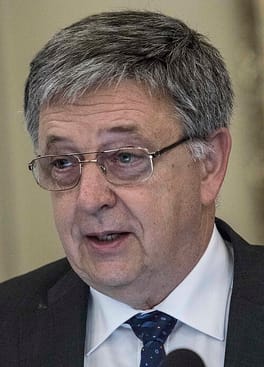
Photo: Európa Pont / CC BY 2.0 (source: Wikimedia Commons)
László Lovász is a mathematician, computer scientist and university teacher. László Lovász was born in Budapest, Hungary on March 9, 1948. That works out to 78 years old in 2026. Schooling on record includes Eötvös Loránd University. Listed accolades include Wolf Prize in Mathematics (1999), Knuth Prize (1999), Gödel Prize (2001) and 5 more.
My Take
Lovász is the kind of mind I find quietly thrilling. The Wolf, Gödel, and Kyoto Prizes are extraordinary, but what impresses me more is that his name now lives inside theorems and conditions that working researchers invoke every day. That is a rarer immortality than any medal. He also chose service, leading the International Mathematical Union and the Hungarian Academy of Sciences, which suggests a person who cares about the health of his whole field, not just his own results. In an era that rewards noise, I admire a combinatorialist whose influence is this deep and this understated.
This take was written by generative AI, one per person, from publicly reported facts (editorial policy). It is a reading of the record, not reporting.
1. Profile
- Name (English)
- László Lovász
- Name (Japanese)
- ラースロー・ロヴァース
- Reading
- らーすろー・ろゔぁーす
- Born
- March 9, 1948 (age 78)
- Origin
- Budapest, Hungary
- Occupation
- mathematician / computer scientist / university teacher
- Zodiac / Chinese zodiac
- Pisces / Rat
2. Background
- University
- Eötvös Loránd University
Awards & achievements
- 1999 Wolf Prize in Mathematics
- 1999 Knuth Prize
- 2001 Gödel Prize
- 1982 Fulkerson Prize
- 1993 Brouwer Medal
- 1979 George Pólya Prize
- 2006 John von Neumann Theory Prize
- 2010 Kyoto Prize
3. Links
- Official sitehttps://www.cs.elte.hu/~lovasz/
- Wikipedia (English)https://en.wikipedia.org/wiki/L%C3%A1szl%C3%B3%20Lov%C3%A1sz
- Wikipedia (Japanese)https://ja.wikipedia.org/wiki/%E3%83%A9%E3%83%BC%E3%82%B9%E3%83%AD%E3%83%BC%E3%83%BB%E3%83%AD%E3%83%B4%E3%82%A1%E3%83%BC%E3%82%B9
- Wikidatahttps://www.wikidata.org/wiki/Q357918
4. About this entry
Tags
- Last updated
Facts are limited to publicly available information up to 2024; non-public or unconfirmed items are omitted. English text is machine-assisted (facts translated by Sonnet, "My Take" written by Opus 4.8). The Japanese page is the source of record.
Frequently asked questions
When was László Lovász born?
Born March 9, 1948 (age 78).
Where is László Lovász from?
László Lovász is from Budapest, Hungary.
What does László Lovász do?
László Lovász works as mathematician, computer scientist, university teacher.
Mathematician — see all → · Computer scientist — see all → · More people from Hungary →