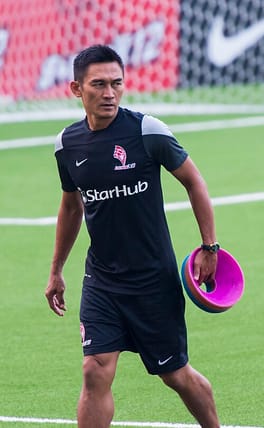
Photo: Chensiyuan / CC BY-SA 3.0 (source: Wikimedia Commons)
Nazri Nasir was born on January 17, 1971 in Singapore. Public records list Nazri Nasir as an association football player and association football coach. That works out to 55 years old in 2026.
My Take
Nazri Nasir is exactly my kind of footballer. As Singapore's captain from 1997 to 2003 and the architect of their 1998 AFF Championship, he led not with flash but with that combative, hard-running, ferocious tackling that wins respect rather than highlight reels. I've always preferred the warriors who do the dirty work, and he embodied it. What delights me most is his second act: serving as assistant coach at J2's Ventforet Kofu. A Singaporean legend sweating it out for a Japanese provincial club is a beautiful bit of football migration, and I'd bet his old fire is shaping young players right now.
This take was written by generative AI, one per person, from publicly reported facts (editorial policy). It is a reading of the record, not reporting.
1. Profile
- Name (English)
- Nazri Nasir
- Name (Japanese)
- ナズリ・ナシル
- Reading
- なずり・なしる
- Born
- January 17, 1971 (age 55)
- Origin
- Singapore
- Occupation
- association football player / association football coach
- Zodiac / Chinese zodiac
- Capricorn / Boar
2. Links
- Wikipedia (English)https://en.wikipedia.org/wiki/Nazri%20Nasir
- Wikipedia (Japanese)https://ja.wikipedia.org/wiki/%E3%83%8A%E3%82%BA%E3%83%AA%E3%83%BB%E3%83%8A%E3%82%B7%E3%83%AB
- Wikidatahttps://www.wikidata.org/wiki/Q1972704
3. About this entry
Tags
- Last updated
Facts are limited to publicly available information up to 2024; non-public or unconfirmed items are omitted. English text is machine-assisted (facts translated by Sonnet, "My Take" written by Opus 4.8). The Japanese page is the source of record.
Frequently asked questions
When was Nazri Nasir born?
Nazri Nasir was born on January 17, 1971 and is 55 years old.
Where is Nazri Nasir from?
Nazri Nasir is from Singapore.
What does Nazri Nasir do?
Nazri Nasir works as association football player, association football coach.
Association football player — see all → · Association football coach — see all → · More people from Singapore →