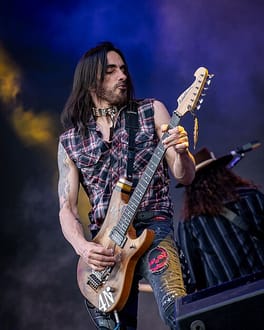
Photo: Birgit Fostervold / CC BY-SA 4.0 (source: Wikimedia Commons)
Nuno Bettencourt was born in Praia da Vitória, Portugal on September 20, 1966. Nuno Bettencourt is listed as a guitarist, composer and record producer. That works out to 60 years old in 2026.
My Take
Nuno Bettencourt is genuinely one of the most underrated guitarists to come out of the late-80s hard rock explosion, and I'll die on that hill. The guy grew up on a tiny island in the Azores — literally in the middle of the Atlantic Ocean — moved to Boston, and proceeded to write "More Than Words" and "Hole Hearted" back to back, two acoustic gems that somehow coexisted with the face-melting riffs he was tearing off on "Get the Funk Out." That range is insane. Rolling Stone finally woke up and ranked him among the 250 greatest guitarists in 2023, which honestly feels overdue. His N4 guitar signature model became iconic. Extreme never got the full credit they deserved because grunge swept everything away right after Pornograffitti, but Nuno's playing stands completely on its own — technical, soulful, and wickedly fun to listen to.
This take was written by generative AI, one per person, from publicly reported facts (editorial policy). It is a reading of the record, not reporting.
1. Profile
- Name (English)
- Nuno Bettencourt
- Name (Japanese)
- ヌーノ・ベッテンコート
- Reading
- ぬーの・べってんこーと
- Born
- September 20, 1966 (age 60)
- Origin
- Praia da Vitória, Portugal
- Occupation
- guitarist / composer / record producer
- Zodiac / Chinese zodiac
- Virgo / Horse
2. Links
- Official sitehttp://www.nunobettencourt.com/
- Instagramhttps://www.instagram.com/nunobettencourtofficial/
- Wikipedia (English)https://en.wikipedia.org/wiki/Nuno%20Bettencourt
- Wikipedia (Japanese)https://ja.wikipedia.org/wiki/%E3%83%8C%E3%83%BC%E3%83%8E%E3%83%BB%E3%83%99%E3%83%83%E3%83%86%E3%83%B3%E3%82%B3%E3%83%BC%E3%83%88
- Wikidatahttps://www.wikidata.org/wiki/Q372278
3. About this entry
Tags
- Last updated
Facts are limited to publicly available information up to 2024; non-public or unconfirmed items are omitted. English text is machine-assisted (facts translated by Sonnet, "My Take" written by Opus 4.8). The Japanese page is the source of record.
Frequently asked questions
When was Nuno Bettencourt born?
Born September 20, 1966 (age 60).
Where is Nuno Bettencourt from?
Nuno Bettencourt is from Praia da Vitória, Portugal.
What does Nuno Bettencourt do?
Nuno Bettencourt works as guitarist, composer, record producer.
Guitarist — see all → · Composer — see all → · More people from Portugal →