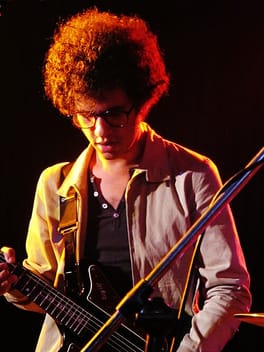
Photo: remixyourface / CC BY 2.0 (source: Wikimedia Commons)
My Take
Omar Rodríguez-López is the most fearlessly prolific guitarist of his generation, and that restlessness is exactly what I love about him. The Mars Volta's De-Loused in the Comatorium remains a landmark of maximalist prog, and his playing there is jagged, jazz-warped and totally his own. What really sets him apart is the sheer output: solo records pouring out faster than anyone can keep up, in genres that range from dub to noise. Some of it is gloriously self-indulgent, sure, but I would rather an artist over-create than play it safe. As a producer and bandleader he treats the studio like an instrument, and the results are endlessly surprising.
This take was written by generative AI, one per person, from publicly reported facts (editorial policy). It is a reading of the record, not reporting.
Overview
Omar Rodríguez-López (born 1975 in Bayamón, Puerto Rico) is an American musician, composer, producer and film director. He is best known as the guitarist, primary songwriter and producer of the progressive rock band The Mars Volta, which he co-founded with Cedric Bixler-Zavala after the breakup of the post-hardcore group At the Drive-In. He is also extraordinarily prolific as a solo artist, releasing dozens of experimental albums.
1. Profile
- Name (English)
- Omar Rodríguez-López
- Name (Japanese)
- オマー・ロドリゲス=ロペス
- Reading
- おまー・ろどりげす=ろぺす
- Born
- September 1, 1975 (age 51)
- Origin
- Bayamón, Puerto Rico, United States
- Occupation
- Composer / Jazz musician / Guitarist / Songwriter / Film director
- Zodiac / Chinese zodiac
- Virgo / Rabbit
2. Links
- Official sitehttp://www.myspace.com/omarrodriguezlopezquintet
- Xhttps://x.com/orlproductions
- Wikipedia (English)https://en.wikipedia.org/wiki/Omar%20Rodr%C3%ADguez-L%C3%B3pez
- Wikipedia (Japanese)https://ja.wikipedia.org/wiki/%E3%82%AA%E3%83%9E%E3%83%BC%E3%83%BB%E3%83%AD%E3%83%89%E3%83%AA%E3%82%B2%E3%82%B9%E3%83%BB%E3%83%AD%E3%83%9A%E3%82%B9
- Wikidatahttps://www.wikidata.org/wiki/Q335579
3. About this entry
Tags
- Last updated
Facts are limited to publicly available information up to 2024; non-public or unconfirmed items are omitted. English text is machine-assisted (facts translated by Sonnet, "My Take" written by Opus 4.8). The Japanese page is the source of record.
Frequently asked questions
When was Omar Rodríguez-López born?
Omar Rodríguez-López was born on September 1, 1975 and is 51 years old.
Where is Omar Rodríguez-López from?
Omar Rodríguez-López is from Bayamón, Puerto Rico, United States.
What does Omar Rodríguez-López do?
Omar Rodríguez-López works as Composer, Jazz musician, Guitarist, Songwriter, Film director.
Composer — see all → · Jazz musician — see all → · More people from the United States → · More people born on September 1 →