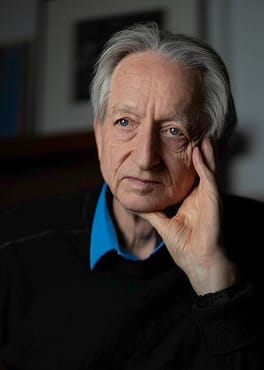
Photo: Cmichel67 / CC BY-SA 4.0 (source: Wikimedia Commons)
My Take
Geoffrey Hinton earns my deepest respect for a quality rarer than brilliance: stubbornness in the face of fashionable doubt. He kept faith with neural networks through decades when the field dismissed them, and the modern AI boom is essentially his vindication. What moves me even more is the final act, in which the so-called Godfather of AI became its most credible critic, openly warning about the dangers of his own creation. It takes unusual integrity to question your life's work at the moment of its greatest triumph. To me he embodies what science should be: patient, contrarian, and honest to the end.
1. Profile
- Name (English)
- ジェフリー・ヒントン
- Name (Japanese)
- ジェフリー・ヒントン
- Reading
- じぇふりー・ひんとん
- Born
- December 6, 1947 (age 78)
- Zodiac / Chinese zodiac
- Sagittarius / Boar
- Origin
- Wimbledon, United Kingdom
- Occupation
- computer scientist / artificial intelligence researcher / university teacher / neuroscientist / psychologist
2. Background
- University
- University of Edinburgh
Awards & achievements
- 1998 Fellow of the Royal Society
- 2014 IEEE Frank Rosenblatt Award
- 2001 Rumelhart Prize
- 2005 IJCAI Award for Research Excellence
- 2016 BBVA Foundation Frontiers of Knowledge Award
- 1990 AAAI Fellow
- 2003 Fellow of the Cognitive Science Society
- 2010 Gerhard Herzberg Canada Gold Medal for Science and Engineering
4. Personality
Motto
Private
6. Links
Frequently asked questions
When was ジェフリー・ヒントン born?
Born December 6, 1947 (age 78).
Where is ジェフリー・ヒントン from?
ジェフリー・ヒントン is from Wimbledon, United Kingdom.
What does ジェフリー・ヒントン do?
ジェフリー・ヒントン works as computer scientist, artificial intelligence researcher, university teacher, neuroscientist, psychologist.
Computer scientist — see all → · More people from United Kingdom →
7. About this entry
Tags
- Last updated
- 2026-06-11
Facts are limited to publicly available information up to 2024; non-public or unconfirmed items are omitted. English text is machine-assisted (facts translated by Sonnet, "My Take" written by Opus 4.8). The Japanese page is the source of record.