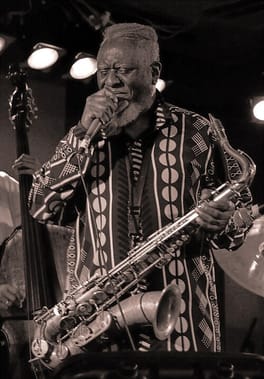
Photo: Dmitry Scherbie New York / CC BY-SA 2.0 (source: Wikimedia Commons)
Pharoah Sanders was a jazz saxophonist, recording artist and jazz musician, born on October 13, 1940 in Little Rock, Arkansas, United States. Pharoah Sanders died on September 24, 2022, aged 81. Schooling on record includes North Little Rock High School. Awards on record include NEA Jazz Masters.
My Take
Pharoah Sanders was the kind of musician who made you feel like the saxophone was reaching somewhere beyond music entirely. Growing up in Little Rock, Arkansas and eventually landing in New York, he came up playing with John Coltrane in the mid-1960s at a moment when jazz was genuinely trying to touch the infinite — and Sanders wasn't just along for the ride, he was pushing the whole thing further with his overblowing, multiphonics, and those cascading sheets of sound that felt more like weather than notes. His solo work, especially albums like Karma with its epic "The Creator Has a Master Plan," showed he had his own deep spiritual vision. The NEA Jazz Masters honor was well deserved, though honestly no award really captures what he did. He passed in September 2022, and the world lost one of the last direct links to that fearless, searching era of jazz.
This take was written by generative AI, one per person, from publicly reported facts (editorial policy). It is a reading of the record, not reporting.
1. Profile
- Name (English)
- Pharoah Sanders
- Name (Japanese)
- ファラオ・サンダース
- Reading
- ふぁらお・さんだーす
- Born
- October 13, 1940 – September 24, 2022
- Origin
- Little Rock, Arkansas, United States
- Occupation
- jazz saxophonist / recording artist / saxophonist / jazz musician / singer
- Zodiac / Chinese zodiac
- Libra / Dragon
2. Background
- High school
- North Little Rock High School
Awards & achievements
- NEA Jazz Masters
3. Links
- Official sitehttp://pharoahsandersjazz.com/
- Instagramhttps://www.instagram.com/pharoahsandersofficial/
- Wikipedia (English)https://en.wikipedia.org/wiki/Pharoah%20Sanders
- Wikipedia (Japanese)https://ja.wikipedia.org/wiki/%E3%83%95%E3%82%A1%E3%83%A9%E3%82%AA%E3%83%BB%E3%82%B5%E3%83%B3%E3%83%80%E3%83%BC%E3%82%B9
- Wikidatahttps://www.wikidata.org/wiki/Q470617
4. About this entry
Tags
- Last updated
Facts are limited to publicly available information up to 2024; non-public or unconfirmed items are omitted. English text is machine-assisted (facts translated by Sonnet, "My Take" written by Opus 4.8). The Japanese page is the source of record.
Frequently asked questions
When was Pharoah Sanders born?
Born October 13, 1940.
When did Pharoah Sanders die?
Died September 24, 2022, aged 81.
Where was Pharoah Sanders from?
Pharoah Sanders was from Little Rock, Arkansas, United States.
What did Pharoah Sanders do?
Pharoah Sanders worked as jazz saxophonist, recording artist, saxophonist, jazz musician, singer.
Recording artist — see all → · More people from the United States →