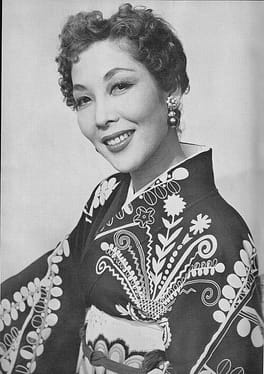
Photo: 時事世界社 (Jiji Sekai-sha). / Public domain (source: Wikimedia Commons)
My Take
I'll admit I came to Fubuki Koshiji late, but the moment her voice hits you understand why people called her the Queen of Chanson. There's this Takarazuka-trained poise to her, all stage presence and theatrical command, yet she never oversings. "Sans Toi Mamie" and "Rokudenashi" are the ones that get me, French songs reborn in Japanese with such intimacy you forget they crossed an ocean. What I love is how restrained she is. No showy runs, just color and quiet ache bleeding through every line until your chest tightens. Born in 1920s Tokyo, gone too soon at 56, she still feels like the gold standard of what a chanteuse should be. Decades later her records hold up beautifully, and I find myself thinking, yeah, that's the real thing right there.
This take was written by generative AI, one per person, from publicly reported facts (editorial policy). It is a reading of the record, not reporting.
Overview
Fubuki Koshiji (February 18, 1924 – November 7, 1980) was a Japanese singer and actress born in Kojimachi, Tokyo. She became the defining interpreter of French chanson for Japanese audiences, most notably through her Japanese-language versions of "Hymne à l'amour", "Save the Last Dance for Me", "Sans toi ma mie" and "Rokudenashi". In 1965 she received the singing award at the 7th Japan Record Awards, and she also received the Golden Arrow Award, cementing her status as one of the foremost entertainers of the Showa era. She passed away in 1980 at the age of 56.
1. Profile
- Name (English)
- Fubuki Koshiji
- Name (Japanese)
- 越路吹雪
- Reading
- こしじ ふぶき
- Born
- February 18, 1924 – November 7, 1980
- Origin
- Kojimachi, Tokyo, Japan
- Occupation
- Singer / Recording Artist / Actor
- Zodiac / Chinese zodiac
- Aquarius / Rat
- Active years
- 1937 - 1980
2. Background
Awards & achievements
- 1965 — Japan Record Award (7th)
- Golden Arrow Award (year unknown)
3. Works & records
Works summary
- Appearances
- 185 (1950–2024)
- By year (titles with a known year)
- 1950: 1, 1951: 5, 1952: 8, 1953: 7, 1954: 6, 1955: 9, 1956: 2, 1957: 1, 1960: 1, 1961: 3, 1962: 3, 1963: 1, 1964: 2, 1965: 16, 1966: 8, 1967: 2, 1968: 11, 1969: 9, 1970: 8, 1971: 6, 1972: 1, 1973: 3, 1974: 1, 1975: 3, 1976: 3, 1977: 6, 1978: 8, 1979: 2, 1981: 1, 1982: 2, 1983: 1, 1985: 2, 1986: 2, 1988: 1, 1989: 1, 1990: 1, 1992: 2, 1996: 1, 2001: 1, 2002: 1, 2003: 2, 2004: 1, 2005: 3, 2006: 2, 2007: 1, 2010: 1, 2012: 4, 2013: 1, 2016: 1, 2018: 3, 2024: 1, year unknown: 13
- Debut work
- 東京の門
Filmography / notable works
| Category | Title |
|---|---|
| Representative Work | Sans toi Mamie (San Towa Mami) |
| Representative Work | Le Mauvais Garçon (Rokudenashi) |
4. Links
- Wikipedia (Japanese)https://ja.wikipedia.org/wiki/%E8%B6%8A%E8%B7%AF%E5%90%B9%E9%9B%AA
- Wikidatahttps://www.wikidata.org/wiki/Q11636632
5. About this entry
Tags
- Last updated
Facts are limited to publicly available information up to 2024; non-public or unconfirmed items are omitted. Works and profile fields sourced from Wikipedia reflect content as of 2026-08-26. English text is machine-assisted (facts translated by Sonnet, "My Take" written by Opus 4.8). The Japanese page is the source of record.
Frequently asked questions
When was Fubuki Koshiji born?
Fubuki Koshiji was born on February 18, 1924.
When did Fubuki Koshiji die?
Fubuki Koshiji died on November 7, 1980, aged 56.
Where was Fubuki Koshiji from?
Fubuki Koshiji was from Kojimachi, Tokyo, Japan.
What did Fubuki Koshiji do?
Fubuki Koshiji worked as Singer, Recording Artist, Actor.
When was Fubuki Koshiji active?
Fubuki Koshiji was active from 1937 to 1980.
What was Fubuki Koshiji known for?
Fubuki Koshiji's notable works include Sans toi Mamie (San Towa Mami), Le Mauvais Garçon (Rokudenashi).
Singer — see all → · Recording Artist — see all → · More people from Japan → · More people born on February 18 →