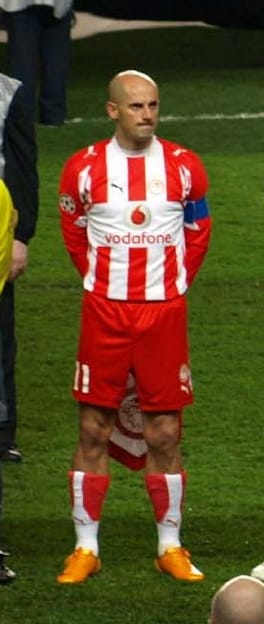
Photo: John Dobson. / CC BY-SA 2.0 (source: Wikimedia Commons)
Predrag Đorđević, born on August 4, 1972 in Kragujevac, Serbia, is an association football player. That puts Predrag Đorđević at 54 years old in 2026. The listed height is 184 cm.
My Take
Predrag Đorđević is loyalty made flesh, and I find that rare and moving in modern football. Thirteen seasons at Olympiacos, the club's greatest foreign goalscorer, a goal roughly every three league games, and a fixture of their golden era of titles. From Kragujevac in Serbia he became a Piraeus institution. In an age of restless transfers and short memories, a left midfielder who plants his flag and stays, scoring set pieces like an artisan, is the sort of player I cherish. Greatness measured not just in goals but in devotion to one badge feels increasingly precious, and he embodied it fully.
This take was written by generative AI, one per person, from publicly reported facts (editorial policy). It is a reading of the record, not reporting.
1. Profile
- Name (English)
- Predrag Đorđević
- Name (Japanese)
- プレドラグ・ジョルジェヴィッチ
- Reading
- ぷれどらぐ・じょるじぇゔぃっち
- Born
- August 4, 1972 (age 54)
- Origin
- Kragujevac, Serbia
- Height
- 184 cm
- Occupation
- association football player
- Zodiac / Chinese zodiac
- Leo / Rat
2. Links
- Wikipedia (English)https://en.wikipedia.org/wiki/Predrag%20%C4%90or%C4%91evi%C4%87
- Wikipedia (Japanese)https://ja.wikipedia.org/wiki/%E3%83%97%E3%83%AC%E3%83%89%E3%83%A9%E3%82%B0%E3%83%BB%E3%82%B8%E3%83%A7%E3%83%AB%E3%82%B8%E3%82%A7%E3%83%B4%E3%82%A3%E3%83%83%E3%83%81
- Wikidatahttps://www.wikidata.org/wiki/Q448099
3. About this entry
Tags
- Last updated
Facts are limited to publicly available information up to 2024; non-public or unconfirmed items are omitted. English text is machine-assisted (facts translated by Sonnet, "My Take" written by Opus 4.8). The Japanese page is the source of record.
Frequently asked questions
When was Predrag Đorđević born?
Born August 4, 1972 (age 54).
Where is Predrag Đorđević from?
Predrag Đorđević is from Kragujevac, Serbia.
What does Predrag Đorđević do?
Predrag Đorđević works as association football player.
How tall is Predrag Đorđević?
Predrag Đorđević is 184 cm.
Association football player — see all → · More people from Serbia →