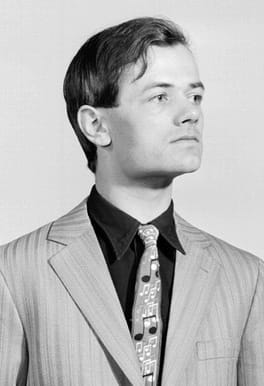
Photo: Maurice Seymour Studio - New York / Public domain (source: Wikimedia Commons)
Ralf Hütter is a singer, experimental musician and songwriter. Ralf Hütter was born in Krefeld, North Rhine-Westphalia, Germany on August 20, 1946. The age as of 2026 is 80.
My Take
Ralf Hütter is genuinely one of the most consequential figures in all of modern music, and I don't think that's even a hot take at this point — it's just true. He and Florian Schneider built Kraftwerk from the ground up in Düsseldorf starting in 1970, and what they did with synthesizers, drum machines, and a very deliberate aesthetic was completely unlike anything anyone else was doing. The idea that machines could be the instrument, that repetition and precision were artistic choices rather than laziness — that was radical. And the ripple effects are staggering: techno, hip-hop, synth-pop, ambient, EDM — all of it has Kraftwerk's fingerprints somewhere in the DNA. Hütter being the sole constant across every album makes him essentially the keeper of the flame, and the fact that he's still out there performing shows with those iconic visual setups past the age of seventy just adds to the legend.
This take was written by generative AI, one per person, from publicly reported facts (editorial policy). It is a reading of the record, not reporting.
1. Profile
- Name (English)
- Ralf Hütter
- Name (Japanese)
- ラルフ・ヒュッター
- Reading
- らるふ・ひゅったー
- Born
- August 20, 1946 (age 80)
- Origin
- Krefeld, North Rhine-Westphalia, Germany
- Occupation
- musician / singer / experimental musician / songwriter / record producer
- Zodiac / Chinese zodiac
- Leo / Dog
2. Links
3. About this entry
Tags
- Last updated
Only publicly available facts are listed; non-public or unconfirmed items are omitted. Base data was compiled from Wikidata from June 2026 onward; ages are recalculated daily and deaths are checked against Wikidata on an ongoing basis. English text is machine-assisted (facts translated by Sonnet, "My Take" written by Opus 4.8). The Japanese page is the source of record.
Frequently asked questions
When was Ralf Hütter born?
Ralf Hütter was born on August 20, 1946 and is 80 years old.
Where is Ralf Hütter from?
Ralf Hütter is from Krefeld, North Rhine-Westphalia, Germany.
What does Ralf Hütter do?
Ralf Hütter works as musician, singer, experimental musician, songwriter, record producer.
Musician — see all → · Singer — see all → · More people from Germany → · More people born on August 20 →