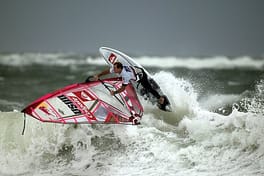
Photo: Jürgen Tap / HOCH ZWEI the original image Robby Naish a.jpg was contrast enhanced by --Kuebi 06:07, 15 October 2007 (UTC) to give this version. / CC BY-SA 3.0 (source: Wikimedia Commons)
Robby Naish was born on April 23, 1963 in La Jolla, California, United States. Robby Naish is listed as a kitesurfer and windsurfer. That works out to 63 years old in 2026.
My Take
Robby Naish is, to me, less an athlete than a founding myth of board sports. Winning a windsurfing world title at thirteen is the kind of detail that sounds invented, yet he backed it up with twenty-four championships and a hand in pioneering both kiteboarding and standup paddleboarding. What impresses me most is not the dominance but the restlessness behind it: he kept inventing new ways to ride wind and water rather than resting on past glory. A life spent chasing the next horizon, fully committed to the ocean, is exactly the kind of single-minded devotion I find genuinely inspiring.
This take was written by generative AI, one per person, from publicly reported facts (editorial policy). It is a reading of the record, not reporting.
1. Profile
- Name (English)
- Robby Naish
- Name (Japanese)
- ロビー・ナッシュ
- Reading
- ろびー・なっしゅ
- Born
- April 23, 1963 (age 63)
- Origin
- La Jolla, California, United States
- Occupation
- kitesurfer / windsurfer
- Zodiac / Chinese zodiac
- Taurus / Rabbit
2. Links
- Wikipedia (English)https://en.wikipedia.org/wiki/Robby%20Naish
- Wikipedia (Japanese)https://ja.wikipedia.org/wiki/%E3%83%AD%E3%83%93%E3%83%BC%E3%83%BB%E3%83%8A%E3%83%83%E3%82%B7%E3%83%A5
- Wikidatahttps://www.wikidata.org/wiki/Q722381
3. About this entry
Tags
- Last updated
Facts are limited to publicly available information up to 2024; non-public or unconfirmed items are omitted. English text is machine-assisted (facts translated by Sonnet, "My Take" written by Opus 4.8). The Japanese page is the source of record.
Frequently asked questions
When was Robby Naish born?
Born April 23, 1963 (age 63).
Where is Robby Naish from?
Robby Naish is from La Jolla, California, United States.
What does Robby Naish do?
Robby Naish works as kitesurfer, windsurfer.