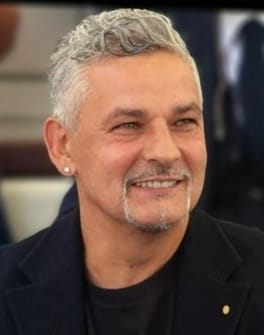
Photo: AbolfaZl0990 / CC BY-SA 4.0 (source: Wikimedia Commons)
Born on February 18, 1967 in Caldogno, Province of Vicenza, Italy, Roberto Baggio is an association football player. Roberto Baggio is 59 years old as of 2026. Listed accolades include Ballon d'Or (1993), Bravo Award (1990), Knight of the Order of Merit of the Italian Republic (1991) and 3 more. The listed height is 174 cm.
My Take
Baggio is, to me, the most poetic figure football ever produced. The 1993 Ballon d'Or and FIFA World Player honors confirm his genius, but what lingers is the image of him standing alone after that 1994 World Cup final penalty. He carried beauty and melancholy in equal measure, and that fragility is precisely what made him immortal. From Caldogno in the province of Vicenza he became the definition of the fantasista, a player who treated the pitch like a canvas. I admire athletes who win, but I love the ones who make you feel something, and Baggio does that every time I picture him.
This take was written by generative AI, one per person, from publicly reported facts (editorial policy). It is a reading of the record, not reporting.
1. Profile
- Name (English)
- Roberto Baggio
- Name (Japanese)
- ロベルト・バッジョ
- Reading
- ろべると・ばっじょ
- Born
- February 18, 1967 (age 59)
- Origin
- Caldogno, Province of Vicenza, Italy
- Height
- 174 cm
- Occupation
- association football player
- Zodiac / Chinese zodiac
- Aquarius / Goat
2. Background
Awards & achievements
- 1993 Ballon d'Or
- 1990 Bravo Award
- 1991 Knight of the Order of Merit of the Italian Republic
- 1993 FIFA World Player of the Year
- 2003 Golden Foot
- Mundial
3. Links
- Official sitehttp://www.robertobaggio.com/
- Wikipedia (English)https://en.wikipedia.org/wiki/Roberto%20Baggio
- Wikipedia (Japanese)https://ja.wikipedia.org/wiki/%E3%83%AD%E3%83%99%E3%83%AB%E3%83%88%E3%83%BB%E3%83%90%E3%83%83%E3%82%B8%E3%83%A7
- Wikidatahttps://www.wikidata.org/wiki/Q67964
4. About this entry
Tags
- Last updated
Facts are limited to publicly available information up to 2024; non-public or unconfirmed items are omitted. English text is machine-assisted (facts translated by Sonnet, "My Take" written by Opus 4.8). The Japanese page is the source of record.
Frequently asked questions
When was Roberto Baggio born?
Roberto Baggio was born on February 18, 1967 and is 59 years old.
Where is Roberto Baggio from?
Roberto Baggio is from Caldogno, Province of Vicenza, Italy.
What does Roberto Baggio do?
Roberto Baggio works as association football player.
How tall is Roberto Baggio?
Roberto Baggio is 174 cm tall.
Association football player — see all → · More people from Italy → · More people born on February 18 →