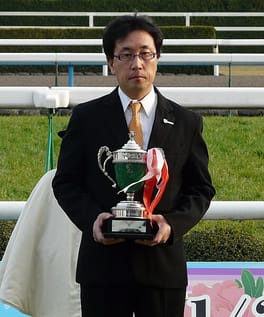
Photo: Cake6 (talk) / CC BY-SA 3.0 (source: Wikimedia Commons)
My Take
He made his way down to Kyoto Sangyo University, which means he traded Hokkaido's open skies for the dense, layered culture of ancient Kyoto, and that kind of geographic leap tends to shape a person in ways that don't show up on a resume. He came of age right as Japan's bubble economy was inflating and then spectacularly popping, and that generation carries a certain groundedness — they've seen both the excess and the hangover. He comes from a family steeped in racing — his father trained Narita Brian — and has quietly built a stable with eight Grade 1 wins; it suggests a guy comfortable enough in his own lane that he doesn't need the validation.
This take was written by generative AI, one per person, from publicly reported facts (editorial policy). It is a reading of the record, not reporting.
Overview
Ryūji Ōkubo (born January 6, 1966) is a Japanese racehorse trainer from Hokkaido, based at the Japan Racing Association's Ritto Training Center. The son of the trainer who handled Narita Brian, he attended Kyoto Sangyo University, opened his own stable in 2003, and has won eight Grade 1 races.
1. Profile
- Name (English)
- Ryūji Ōkubo
- Name (Japanese)
- 大久保龍志
- Reading
- おおくぼ りゅうじ
- Born
- January 6, 1966 (age 60)
- Origin
- Hokkaido, Japan
- Occupation
- Horse Trainer
- Zodiac / Chinese zodiac
- Capricorn / Horse
2. Background
- University
- Kyoto Sangyo University
3. Links
4. About this entry
Tags
- Last updated
Only publicly available facts are listed; non-public or unconfirmed items are omitted. Base data was compiled from Wikidata from June 2026 onward; ages are recalculated daily and deaths are checked against Wikidata on an ongoing basis. English text is machine-assisted (facts translated by Sonnet, "My Take" written by Opus 4.8). The Japanese page is the source of record.
Frequently asked questions
When was Ryūji Ōkubo born?
Ryūji Ōkubo was born on January 6, 1966 and is 60 years old.
Where is Ryūji Ōkubo from?
Ryūji Ōkubo is from Hokkaido, Japan.
What does Ryūji Ōkubo do?
Ryūji Ōkubo works as Horse Trainer.
Where did Ryūji Ōkubo study?
Ryūji Ōkubo attended Kyoto Sangyo University.
Horse Trainer — see all → · More people from Japan → · More people born on January 6 →