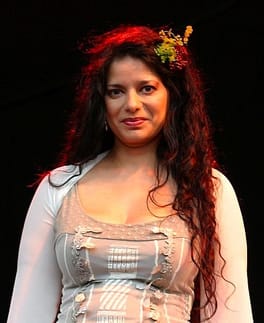
Photo: Sheila_Chandra_-_The_Imagined_Village_-The_Big_Chill_2008.jpg: Mark Bennett derivative work: Stillwaterising (talk) / CC BY 3.0 (source: Wikimedia Commons)
Sheila Chandra is credited as a writer, actor and pop singer. Born on March 14, 1965, Sheila Chandra is from London, United Kingdom. The age as of 2026 is 61.
My Take
Sheila Chandra is an artist I find genuinely transporting. Despite a garbled origin note, she is a London-born English singer of Indian descent who started as a teenage actress before fusing Indian classical traditions with Western pop into a hypnotic drone-voice style all her own. There is a Piscean dreaminess to her sound that few have matched. The cruelest part of her story is its ending: burning mouth syndrome silenced her career in 2009, robbing a singer of the very thing she gave the world. I keep returning to her recordings precisely because they feel like preserved light. Quietly, she earns my deepest respect.
This take was written by generative AI, one per person, from publicly reported facts (editorial policy). It is a reading of the record, not reporting.
1. Profile
- Name (English)
- Sheila Chandra
- Name (Japanese)
- シーラ・チャンドラ
- Reading
- しーら・ちゃんどら
- Born
- March 14, 1965 (age 61)
- Origin
- London, United Kingdom
- Occupation
- singer / writer / actor / pop singer / composer
- Zodiac / Chinese zodiac
- Pisces / Snake
2. Links
- Official sitehttps://www.sheilachandra.com/
- Wikipedia (English)https://en.wikipedia.org/wiki/Sheila%20Chandra
- Wikipedia (Japanese)https://ja.wikipedia.org/wiki/%E3%82%B7%E3%83%BC%E3%83%A9%E3%83%BB%E3%83%81%E3%83%A3%E3%83%B3%E3%83%89%E3%83%A9
- Wikidatahttps://www.wikidata.org/wiki/Q458961
3. About this entry
Tags
- Last updated
Facts are limited to publicly available information up to 2024; non-public or unconfirmed items are omitted. English text is machine-assisted (facts translated by Sonnet, "My Take" written by Opus 4.8). The Japanese page is the source of record.
Frequently asked questions
When was Sheila Chandra born?
Born March 14, 1965 (age 61).
Where is Sheila Chandra from?
Sheila Chandra is from London, United Kingdom.
What does Sheila Chandra do?
Sheila Chandra works as singer, writer, actor, pop singer, composer.
Singer — see all → · Writer — see all → · More people from the United Kingdom →