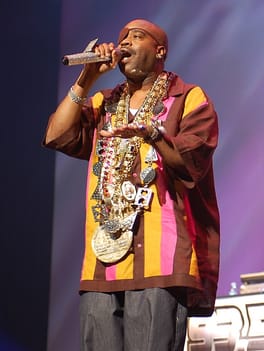
Photo: Brett Hammond / CC BY 2.0 (source: Wikimedia Commons)
Slick Rick is credited as a rapper, singer and record producer. Slick Rick was born on January 14, 1965 in Mitcham, United Kingdom. The age as of 2026 is 61. Schooling on record includes Fiorello H. LaGuardia High School.
My Take
What strikes me most about Slick Rick is that he essentially invented the idea of the rapper as a novelist. Plenty of MCs in the mid-eighties could rhyme; almost none could build a scene, voice multiple characters, and land a punchline the way he did on "La Di Da Di" and "The Show." The fact that "La Di Da Di" became one of the most sampled records ever says it all — generations of artists keep returning to borrow his cadence. That London-born lilt over New York hip-hop gave him a sound nobody has convincingly imitated since. For my money, he is the genre's first true storyteller.
This take was written by generative AI, one per person, from publicly reported facts (editorial policy). It is a reading of the record, not reporting.
1. Profile
- Name (English)
- Slick Rick
- Name (Japanese)
- スリック・リック
- Reading
- すりっく・りっく
- Born
- January 14, 1965 (age 61)
- Origin
- Mitcham, United Kingdom
- Occupation
- rapper / singer / record producer / philanthropist / songwriter
- Zodiac / Chinese zodiac
- Capricorn / Snake
2. Background
- High school
- Fiorello H. LaGuardia High School
3. Links
- Official sitehttps://www.slickrickisart.com/
- Xhttps://x.com/iamSlickRick
- Wikipedia (English)https://en.wikipedia.org/wiki/Slick%20Rick
- Wikipedia (Japanese)https://ja.wikipedia.org/wiki/%E3%82%B9%E3%83%AA%E3%83%83%E3%82%AF%E3%83%BB%E3%83%AA%E3%83%83%E3%82%AF
- Wikidatahttps://www.wikidata.org/wiki/Q708620
4. About this entry
Tags
- Last updated
Facts are limited to publicly available information up to 2024; non-public or unconfirmed items are omitted. English text is machine-assisted (facts translated by Sonnet, "My Take" written by Opus 4.8). The Japanese page is the source of record.
Frequently asked questions
When was Slick Rick born?
Born January 14, 1965 (age 61).
Where is Slick Rick from?
Slick Rick is from Mitcham, United Kingdom.
What does Slick Rick do?
Slick Rick works as rapper, singer, record producer, philanthropist, songwriter.
Rapper — see all → · Singer — see all → · More people from the United Kingdom →