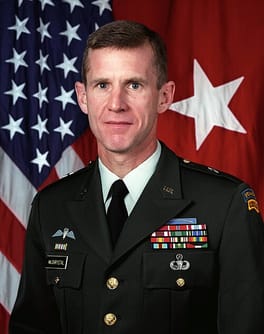
Photo: Scott Davis, Civ / Public domain (source: Wikimedia Commons)
Stanley A. McChrystal, born on August 14, 1954 in Fort Leavenworth, Kansas, United States, is an army officer, military commander and university teacher. As of 2026, Stanley A. McChrystal is 72 years old. Education on record includes St. John's College High School. Listed accolades include Bronze Star Medal, Legionnaire of Legion of Merit, Humanitarian Service Medal and 5 more.
My Take
Stanley McChrystal is a figure I find genuinely complicated. Born at Fort Leavenworth in 1954, he's a retired US Army general best known for commanding Joint Special Operations Command from 2003 to 2008, a period credited with eliminating Abu Musab al-Zarqawi. The decorations are striking to me, the Bronze Star, multiple Distinguished Service Medals, the Legion of Merit. What I keep thinking about is how a career built in the shadows of special operations later turned toward teaching as a university lecturer. That pivot from the battlefield to the classroom is what makes me curious about him, more than the medals themselves.
This take was written by generative AI, one per person, from publicly reported facts (editorial policy). It is a reading of the record, not reporting.
1. Profile
- Name (English)
- Stanley A. McChrystal
- Name (Japanese)
- スタンリー・マクリスタル
- Reading
- すたんりー・まくりすたる
- Born
- August 14, 1954 (age 72)
- Origin
- Fort Leavenworth, Kansas, United States
- Occupation
- army officer / military commander / university teacher / soldier
- Zodiac / Chinese zodiac
- Leo / Horse
2. Background
- High school
- St. John's College High School
- University
- St. John's College High School
Awards & achievements
- Bronze Star Medal
- Legionnaire of Legion of Merit
- Humanitarian Service Medal
- Defense Distinguished Service Medal
- Distinguished Service Medal
- Defense Superior Service Medal
- Legion of Merit
- 2016 Honorary Doctor of Military Science
3. Links
- Xhttps://x.com/stanmcchrystal
- Wikipedia (English)https://en.wikipedia.org/wiki/Stanley%20A.%20McChrystal
- Wikipedia (Japanese)https://ja.wikipedia.org/wiki/%E3%82%B9%E3%82%BF%E3%83%B3%E3%83%AA%E3%83%BC%E3%83%BB%E3%83%9E%E3%82%AF%E3%83%AA%E3%82%B9%E3%82%BF%E3%83%AB
- Wikidatahttps://www.wikidata.org/wiki/Q374338
4. About this entry
Tags
- Last updated
Facts are limited to publicly available information up to 2024; non-public or unconfirmed items are omitted. English text is machine-assisted (facts translated by Sonnet, "My Take" written by Opus 4.8). The Japanese page is the source of record.
Frequently asked questions
When was Stanley A. McChrystal born?
Born August 14, 1954 (age 72).
Where is Stanley A. McChrystal from?
Stanley A. McChrystal is from Fort Leavenworth, Kansas, United States.
What does Stanley A. McChrystal do?
Stanley A. McChrystal works as army officer, military commander, university teacher, soldier.