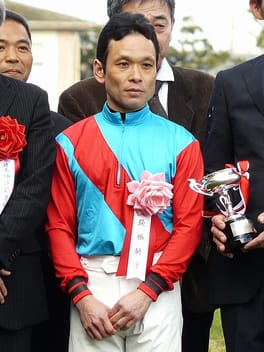
Photo: Cake6 (talk) / CC BY-SA 3.0 (source: Wikimedia Commons)
My Take
Teruo Eda is the kind of jockey who never gets the splashy magazine covers, and honestly that makes me respect him more. Born in February 1972, he's spent decades in the saddle — and if you've never thought hard about what that actually means, let me spell it out: a tiny human, constantly starving himself to make weight, climbing onto a half-ton animal that can hit 70 kilometers an hour, every single weekend, knowing full well a bad step can end everything. He was the youngest jockey in JRA history to win the Tennō Shō, back in 1991, and he has kept showing up ever since, no fanfare required. In a sport that loves its star narratives and flashy stallions, the quiet grinders like Eda are the ones holding the whole thing together, and I think that deserves a lot more recognition than it gets.
This take was written by generative AI, one per person, from publicly reported facts (editorial policy). It is a reading of the record, not reporting.
Overview
Teruo Eda is a Japanese thoroughbred racing jockey born on February 8, 1972. He has competed in Japan's professional horse racing circuit over a career spanning multiple decades. Born in Asakawa, Fukushima Prefecture, and based at the Miho Training Center, he debuted in 1990 and in 1991 became the youngest jockey in JRA history to win the Tennō Shō. He is categorized among Japan's working jockeys and is documented on Wikipedia Japan and Wikidata.
1. Profile
- Name (English)
- Teruo Eda
- Name (Japanese)
- 江田照男
- Reading
- えだ てるお
- Born
- February 8, 1972 (age 54)
- Origin
- Fukushima Prefecture, Japan
- Occupation
- Jockey
- Zodiac / Chinese zodiac
- Aquarius / Rat
2. Links
- Wikipedia (Japanese)https://ja.wikipedia.org/wiki/%E6%B1%9F%E7%94%B0%E7%85%A7%E7%94%B7
- Wikidatahttps://www.wikidata.org/wiki/Q11551268
3. About this entry
Tags
- Last updated
Only publicly available facts are listed; non-public or unconfirmed items are omitted. Base data was compiled from Wikidata from June 2026 onward; ages are recalculated daily and deaths are checked against Wikidata on an ongoing basis. English text is machine-assisted (facts translated by Sonnet, "My Take" written by Opus 4.8). The Japanese page is the source of record.
Frequently asked questions
When was Teruo Eda born?
Teruo Eda was born on February 8, 1972 and is 54 years old.
Where is Teruo Eda from?
Teruo Eda is from Fukushima Prefecture, Japan.
What does Teruo Eda do?
Teruo Eda works as Jockey.
Jockey — see all → · More people from Japan → · More people born on February 8 →