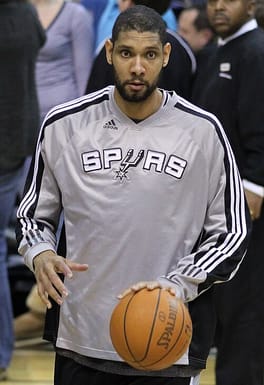
Photo: Keith Allison from Owings Mills, USA / CC BY-SA 2.0 (source: Wikimedia Commons)
Tim Duncan is a basketball player and basketball coach, born on April 25, 1976 in Christiansted, United States. As of 2026, Tim Duncan is 50 years old. Education on record includes St. Dunstan's Episcopal High School and Wake Forest University. Recorded honors include John R. Wooden Award (1997), Best Male College Basketball Player ESPY Award (1997), NBA All-Rookie Team (1998) and 4 more. The listed height is 211 cm.
My Take
Tim Duncan is my favorite argument against the idea that greatness needs noise. A seven-footer from Christiansted who stayed all four years at Wake Forest when leaving early was fashionable, then spent nineteen seasons with a single franchise, winning with bank shots and silence. Rookie of the Year in 1998, Finals MVP by 1999 — the resume arrived almost instantly, yet he never chased attention. What I admire most is his discipline of repetition: doing the boring, correct thing ten thousand times until it becomes art. In an era of brand-building superstars, Duncan proved personality can be expressed through restraint. To me, he is basketball's quietest revolutionary.
This take was written by generative AI, one per person, from publicly reported facts (editorial policy). It is a reading of the record, not reporting.
1. Profile
- Name (English)
- Tim Duncan
- Name (Japanese)
- ティム・ダンカン
- Reading
- てぃむ・だんかん
- Born
- April 25, 1976 (age 50)
- Origin
- Christiansted, United States
- Height
- 211 cm
- Occupation
- basketball player / basketball coach
- Zodiac / Chinese zodiac
- Taurus / Dragon
2. Background
- High school
- St. Dunstan's Episcopal High School
- University
- Wake Forest University
Awards & achievements
- 1997 John R. Wooden Award
- 1997 Best Male College Basketball Player ESPY Award
- 1998 NBA All-Rookie Team
- 1998 NBA Rookie of the Year Award
- 1998 All-NBA Team
- 1999 All-NBA Team
- 1999 NBA All-Defensive Team
- 1999 Bill Russell NBA Finals Most Valuable Player Award
3. Links
- Official sitehttps://www.slamduncan.com/
- Xhttps://x.com/duncanrelief
- Wikipedia (English)https://en.wikipedia.org/wiki/Tim%20Duncan
- Wikipedia (Japanese)https://ja.wikipedia.org/wiki/%E3%83%86%E3%82%A3%E3%83%A0%E3%83%BB%E3%83%80%E3%83%B3%E3%82%AB%E3%83%B3
- Wikidatahttps://www.wikidata.org/wiki/Q193020
4. About this entry
Tags
- Last updated
Facts are limited to publicly available information up to 2024; non-public or unconfirmed items are omitted. English text is machine-assisted (facts translated by Sonnet, "My Take" written by Opus 4.8). The Japanese page is the source of record.
Frequently asked questions
When was Tim Duncan born?
Born April 25, 1976 (age 50).
Where is Tim Duncan from?
Tim Duncan is from Christiansted, United States.
What does Tim Duncan do?
Tim Duncan works as basketball player, basketball coach.
How tall is Tim Duncan?
Tim Duncan is 211 cm.
Basketball player — see all → · Basketball coach — see all → · More people from the United States →