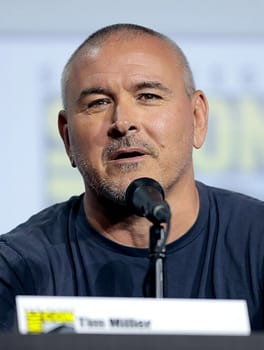
Photo: Gage Skidmore / CC BY-SA 3.0 (source: Wikimedia Commons)
Public records list Tim Miller as a film director, CG artist and screenwriter. Tim Miller was born on October 10, 1964 in Fort Washington, Maryland, United States. That works out to 62 years old in 2026.
My Take
Tim Miller is one of those directors who came up the hard way — building Blur Studio into a respected visual effects powerhouse before Hollywood even knew his name — and then he blew the doors off with Deadpool in 2016, a film everyone in the studio system said was unreleasable. He proved them spectacularly wrong. His background as a CG artist and animator bleeds into everything he touches, giving his work a kinetic, almost tactile energy that pure live-action directors just can't fake. Love, Death & Robots is where I think he's really in his element though — that anthology series is wildly uneven in the best possible way, and the Emmy wins are well deserved. Terminator: Dark Fate was a tough gig with impossible expectations, and honestly I think it was better than it got credit for. He's a guy who clearly loves the craft and takes genuine swings.
This take was written by generative AI, one per person, from publicly reported facts (editorial policy). It is a reading of the record, not reporting.
1. Profile
- Name (English)
- Tim Miller
- Name (Japanese)
- ティム・ミラー
- Reading
- てぃむ・みらー
- Born
- October 10, 1964 (age 62)
- Origin
- Fort Washington, Maryland, United States
- Occupation
- film director / CG artist / screenwriter / film producer / animator
- Zodiac / Chinese zodiac
- Libra / Dragon
2. Links
3. About this entry
Tags
- Last updated
Only publicly available facts are listed; non-public or unconfirmed items are omitted. Base data was compiled from Wikidata from June 2026 onward; ages are recalculated daily and deaths are checked against Wikidata on an ongoing basis. English text is machine-assisted (facts translated by Sonnet, "My Take" written by Opus 4.8). The Japanese page is the source of record.
Frequently asked questions
When was Tim Miller born?
Tim Miller was born on October 10, 1964 and is 62 years old.
Where is Tim Miller from?
Tim Miller is from Fort Washington, Maryland, United States.
What does Tim Miller do?
Tim Miller works as film director, CG artist, screenwriter, film producer, animator.
Film director — see all → · More people from the United States → · More people born on October 10 →