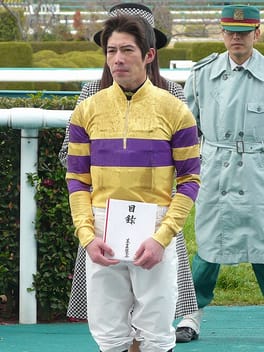
Photo: Cake6 (talk) / CC BY-SA 3.0 (source: Wikimedia Commons)
My Take
Yūichi Shibayama came up in Osaka, which already tells you something: Osaka kids tend to be scrappy, practical, no-nonsense. And jockeys have to be exactly that, because the lifestyle is brutally demanding before you even think about the race itself — the weight control, the physical conditioning, the sheer nerve it takes to sit on top of a thousand-pound animal at full sprint and actually steer. Shibayama strikes me as the craftsman type who keeps his head down and lets the results do the talking, not the kind of guy filling up your social media feed. There's something genuinely admirable about that.
This take was written by generative AI, one per person, from publicly reported facts (editorial policy). It is a reading of the record, not reporting.
Overview
Yūichi Shibayama is a Japanese thoroughbred racing jockey born on February 19, 1978, in Osaka Prefecture, Japan. He competes as a professional jockey, a discipline demanding extreme physical discipline and acute horsemanship. Details about his agency affiliation and career timeline have not been made public.
1. Profile
- Name (English)
- Yūichi Shibayama
- Name (Japanese)
- 柴山雄一
- Reading
- しばやま ゆういち
- Born
- February 19, 1978 (age 48)
- Origin
- Osaka Prefecture, Japan
- Occupation
- Jockey
- Zodiac / Chinese zodiac
- Pisces / Horse
2. Links
- Wikipedia (Japanese)https://ja.wikipedia.org/wiki/%E6%9F%B4%E5%B1%B1%E9%9B%84%E4%B8%80
- Wikidatahttps://www.wikidata.org/wiki/Q11534676
3. About this entry
Tags
- Last updated
Facts are limited to publicly available information up to 2024; non-public or unconfirmed items are omitted. English text is machine-assisted (facts translated by Sonnet, "My Take" written by Opus 4.8). The Japanese page is the source of record.
Frequently asked questions
When was Yūichi Shibayama born?
Born February 19, 1978 (age 48).
Where is Yūichi Shibayama from?
Yūichi Shibayama is from Osaka Prefecture, Japan.
What does Yūichi Shibayama do?
Yūichi Shibayama works as Jockey.