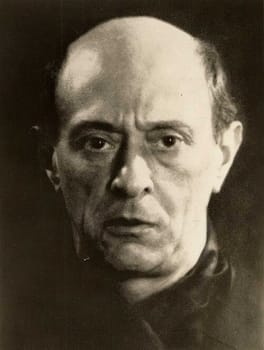
Photo: Man Ray / CC BY-SA 2.0 (source: Wikimedia Commons)
Arnold Schoenberg was born on September 13, 1874 in Vienna, Austria. Arnold Schoenberg was a classical composer, painter and musicologist. Death is recorded on July 13, 1951, at the age of 76. Listed accolades include Honorary Member of the International Society for Contemporary Music. Credited works include Erwartung, Verklärte Nacht and A Survivor from Warsaw.
My Take
Schoenberg is one of those figures where you have to respect the sheer nerve before you even get to the music — this is a guy who looked at centuries of tonal harmony and decided it was holding everyone back. His early work like Verklärte Nacht is lush and romantic, so you can hear he wasn't rejecting beauty; he was chasing something deeper. Then came the twelve-tone system, which sounds dry on paper but in pieces like A Survivor from Warsaw it becomes devastating, raw, genuinely emotional. He fled Nazi Germany, ended up teaching in Los Angeles of all places, and kept working and painting right to the end. Most people still find his mature music difficult, and honestly, I get it — but the composers who came after him had to reckon with everything he broke open, whether they liked it or not.
This take was written by generative AI, one per person, from publicly reported facts (editorial policy). It is a reading of the record, not reporting.
1. Profile
- Name (English)
- Arnold Schoenberg
- Name (Japanese)
- アルノルト・シェーンベルク
- Reading
- あるのると・しぇーんべるく
- Born
- September 13, 1874 – July 13, 1951
- Origin
- Vienna, Austria
- Occupation
- classical composer / painter / musicologist / music theorist / writer
- Zodiac / Chinese zodiac
- Virgo / Dog
2. Background
Awards & achievements
- Honorary Member of the International Society for Contemporary Music
3. Works & records
Filmography / notable works
| Category | Title |
|---|---|
| Notable work | Erwartung |
| Notable work | Verklärte Nacht |
| Notable work | A Survivor from Warsaw |
| Notable work | Coalition Chess |
4. Links
- Official sitehttps://www.schoenberg.org
- Wikipedia (English)https://en.wikipedia.org/wiki/Arnold%20Schoenberg
- Wikipedia (Japanese)https://ja.wikipedia.org/wiki/%E3%82%A2%E3%83%AB%E3%83%8E%E3%83%AB%E3%83%88%E3%83%BB%E3%82%B7%E3%82%A7%E3%83%BC%E3%83%B3%E3%83%99%E3%83%AB%E3%82%AF
- Wikidatahttps://www.wikidata.org/wiki/Q154770
5. About this entry
Tags
- Last updated
Only publicly available facts are listed; non-public or unconfirmed items are omitted. Base data was compiled from Wikidata from June 2026 onward; ages are recalculated daily and deaths are checked against Wikidata on an ongoing basis. English text is machine-assisted (facts translated by Sonnet, "My Take" written by Opus 4.8). The Japanese page is the source of record.
Frequently asked questions
When was Arnold Schoenberg born?
Arnold Schoenberg was born on September 13, 1874.
When did Arnold Schoenberg die?
Arnold Schoenberg died on July 13, 1951, aged 76.
Where was Arnold Schoenberg from?
Arnold Schoenberg was from Vienna, Austria.
What did Arnold Schoenberg do?
Arnold Schoenberg worked as classical composer, painter, musicologist, music theorist, writer.
What was Arnold Schoenberg known for?
Arnold Schoenberg's notable works include Erwartung, Verklärte Nacht, A Survivor from Warsaw.
Painter — see all → · More people from Austria → · More people born on September 13 →