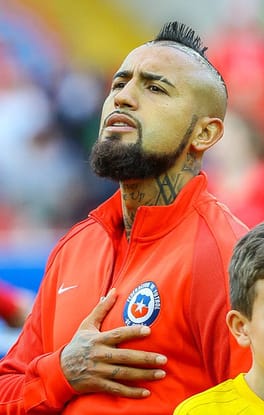
Photo: Дмитрий Садовников / CC BY-SA 3.0 (source: Wikimedia Commons)
Arturo Vidal is listed as an association football player. Arturo Vidal was born in Santiago, Santiago Metropolitan Region, Chile on May 22, 1987. That works out to 39 years old in 2026. The listed height is 180 cm.
My Take
Vidal is my favorite kind of midfielder: the one who does the ugly work so beautifully that it becomes the spectacle. I have always read him as the heartbeat of Chile's golden generation, the snarling engine behind those historic Copa America triumphs, and a player elite European clubs trusted precisely because he never hid from contact or responsibility. The mohawk and the King Arturo bravado are great theater, but what I admire most is the closing chapter: going home to Colo-Colo and captaining his country deep into his thirties. That is a warrior honoring his roots, and I respect it enormously.
This take was written by generative AI, one per person, from publicly reported facts (editorial policy). It is a reading of the record, not reporting.
1. Profile
- Name (English)
- Arturo Vidal
- Name (Japanese)
- アルトゥーロ・ビダル
- Reading
- あるとぅーろ・びだる
- Born
- May 22, 1987 (age 39)
- Origin
- Santiago, Santiago Metropolitan Region, Chile
- Height
- 180 cm
- Occupation
- association football player
- Zodiac / Chinese zodiac
- Gemini / Rabbit
2. Links
- Official sitehttp://www.arturovidal.cl/
- Xhttps://x.com/kingarturo23
- Wikipedia (English)https://en.wikipedia.org/wiki/Arturo%20Vidal
- Wikipedia (Japanese)https://ja.wikipedia.org/wiki/%E3%82%A2%E3%83%AB%E3%83%88%E3%82%A5%E3%83%BC%E3%83%AD%E3%83%BB%E3%83%93%E3%83%80%E3%83%AB
- Wikidatahttps://www.wikidata.org/wiki/Q192671
3. About this entry
Tags
- Last updated
Facts are limited to publicly available information up to 2024; non-public or unconfirmed items are omitted. English text is machine-assisted (facts translated by Sonnet, "My Take" written by Opus 4.8). The Japanese page is the source of record.
Frequently asked questions
When was Arturo Vidal born?
Born May 22, 1987 (age 39).
Where is Arturo Vidal from?
Arturo Vidal is from Santiago, Santiago Metropolitan Region, Chile.
What does Arturo Vidal do?
Arturo Vidal works as association football player.
How tall is Arturo Vidal?
Arturo Vidal is 180 cm.
Association football player — see all → · More people from Chile →