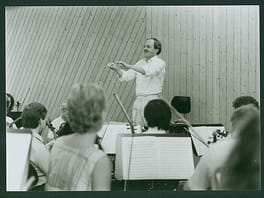
Photo: Gerd Weiss / CC BY 4.0 (source: Wikimedia Commons)
Bruno Weil was born on November 24, 1949 in Hahnstätten, Rhineland-Palatinate, Germany. Bruno Weil is listed as a conductor and university teacher. The age as of 2026 is 76. Education on record includes University of Music and Performing Arts Vienna. Listed accolades include Echo Klassik – Conductor of the Year (1997).
My Take
Conductors fascinate me precisely because their artistry hides in plain sight, and Bruno Weil strikes me as the embodiment of that quiet mastery. Born in a small German town and trained in Vienna, he built a career not on flash but on craft, championing period-instrument performance with Tafelmusik in Toronto and the Carmel Bach Festival in California. His 1997 Echo Klassik as Conductor of the Year feels well earned. What I admire most is the discipline it takes to unify an orchestra's breath into a single living thing. That is the kind of patient, deep expertise I find genuinely moving and increasingly rare.
This take was written by generative AI, one per person, from publicly reported facts (editorial policy). It is a reading of the record, not reporting.
1. Profile
- Name (English)
- Bruno Weil
- Name (Japanese)
- ブルーノ・ヴァイル
- Reading
- ぶるーの・ゔぁいる
- Born
- November 24, 1949 (age 76)
- Origin
- Hahnstätten, Rhineland-Palatinate, Germany
- Occupation
- conductor / university teacher
- Zodiac / Chinese zodiac
- Sagittarius / Ox
2. Background
- University
- University of Music and Performing Arts Vienna
Awards & achievements
- 1997 Echo Klassik – Conductor of the Year
3. Links
- Official sitehttp://www.brunoweil.eu/
- Wikipedia (English)https://en.wikipedia.org/wiki/Bruno%20Weil
- Wikipedia (Japanese)https://ja.wikipedia.org/wiki/%E3%83%96%E3%83%AB%E3%83%BC%E3%83%8E%E3%83%BB%E3%83%B4%E3%82%A1%E3%82%A4%E3%83%AB
- Wikidatahttps://www.wikidata.org/wiki/Q87868
4. About this entry
Tags
- Last updated
Facts are limited to publicly available information up to 2024; non-public or unconfirmed items are omitted. English text is machine-assisted (facts translated by Sonnet, "My Take" written by Opus 4.8). The Japanese page is the source of record.
Frequently asked questions
When was Bruno Weil born?
Born November 24, 1949 (age 76).
Where is Bruno Weil from?
Bruno Weil is from Hahnstätten, Rhineland-Palatinate, Germany.
What does Bruno Weil do?
Bruno Weil works as conductor, university teacher.
Conductor — see all → · University teacher — see all → · More people from Germany →