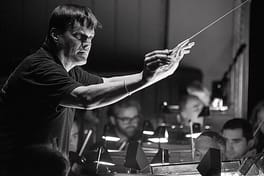
Photo: Christian Michelides / CC BY-SA 4.0 (source: Wikimedia Commons)
Christian Thielemann is a conductor and general music director. Christian Thielemann was born on April 1, 1959 in Berlin, Germany. The age as of 2026 is 67. Listed accolades include Officer's Cross of the Order of Merit of the Federal Republic of Germany, Berliner Bär (2014) and Österreichischer Musiktheaterpreis (2023).
My Take
Christian Thielemann is one of those conductors who makes you feel the full weight of the German tradition the moment he raises the baton — and I mean that as the highest compliment. Born in Berlin in 1959 and trained at the Hanns Eisler School of Music there, he has built his career on exactly the repertoire that demands this kind of gravitational seriousness: Wagner, Bruckner, Strauss. There's nobody working today who draws out the slow-burning architecture of a Bruckner symphony quite like him. His tenure leading the Staatskapelle Berlin and the Staatsoper Unter den Linden has cemented his status as a custodian of the German symphonic canon, and the Officer's Cross of the Order of Merit, the Berliner Bär, and the 2023 Österreichischer Musiktheaterpreis all feel like the establishment finally catching up to what serious listeners already knew.
This take was written by generative AI, one per person, from publicly reported facts (editorial policy). It is a reading of the record, not reporting.
1. Profile
- Name (English)
- Christian Thielemann
- Name (Japanese)
- クリスティアン・ティーレマン
- Reading
- くりすてぃあん・てぃーれまん
- Born
- April 1, 1959 (age 67)
- Origin
- Berlin, Germany
- Occupation
- conductor / music director / general music director
- Zodiac / Chinese zodiac
- Aries / Boar
2. Background
Awards & achievements
- Officer's Cross of the Order of Merit of the Federal Republic of Germany
- 2014 Berliner Bär
- 2023 Österreichischer Musiktheaterpreis
3. Links
4. About this entry
Tags
- Last updated
Facts are limited to publicly available information up to 2024; non-public or unconfirmed items are omitted. English text is machine-assisted (facts translated by Sonnet, "My Take" written by Opus 4.8). The Japanese page is the source of record.
Frequently asked questions
When was Christian Thielemann born?
Born April 1, 1959 (age 67).
Where is Christian Thielemann from?
Christian Thielemann is from Berlin, Germany.
What does Christian Thielemann do?
Christian Thielemann works as conductor, music director, general music director.
Conductor — see all → · Music director — see all → · More people from Germany →