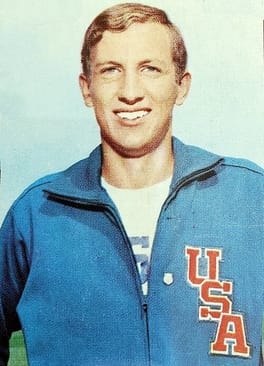
Photo: Unknown author / Public domain (source: Wikimedia Commons)
Dick Fosbury was born in Portland, Oregon, United States on March 6, 1947. Public records list Dick Fosbury as an athletics competitor, politician and athlete. Death is recorded on March 12, 2023, at the age of 76. Schooling on record includes North Medford High School. The listed height was 193 cm.
My Take
Dick Fosbury is genuinely one of those athletes whose entire legacy boils down to a single, audacious idea — and I mean that as the highest compliment possible. Before him, high jumpers went over the bar face-down; he showed up at the 1968 Mexico City Olympics doing it backwards, arching his spine over the bar like it was the most natural thing in the world, and walked away with gold. His coaches at first pushed him to keep practicing the conventional straddle. He proved them wrong so completely that every serious high jumper on the planet has been copying him ever since. That's not just winning a medal — that's rewriting a sport's physics forever. A Portland kid from North Medford High who changed an Olympic event for all time. He passed away in March 2023 at 76, but "the Fosbury flop" will outlive all of us.
This take was written by generative AI, one per person, from publicly reported facts (editorial policy). It is a reading of the record, not reporting.
1. Profile
- Name (English)
- Dick Fosbury
- Name (Japanese)
- ディック・フォスベリー
- Reading
- でぃっく・ふぉすべりー
- Born
- March 6, 1947 – March 12, 2023
- Origin
- Portland, Oregon, United States
- Height
- 193 cm
- Occupation
- athletics competitor / politician / athlete / Olympic competitor
- Zodiac / Chinese zodiac
- Pisces / Boar
2. Background
- High school
- North Medford High School
3. Works & records
Filmography / notable works
| Category | Title |
|---|---|
| Notable work | Fosbury flop |
4. Links
5. About this entry
Tags
- Last updated
Only publicly available facts are listed; non-public or unconfirmed items are omitted. Base data was compiled from Wikidata from June 2026 onward; ages are recalculated daily and deaths are checked against Wikidata on an ongoing basis. English text is machine-assisted (facts translated by Sonnet, "My Take" written by Opus 4.8). The Japanese page is the source of record.
Frequently asked questions
When was Dick Fosbury born?
Dick Fosbury was born on March 6, 1947.
When did Dick Fosbury die?
Dick Fosbury died on March 12, 2023, aged 76.
Where was Dick Fosbury from?
Dick Fosbury was from Portland, Oregon, United States.
What did Dick Fosbury do?
Dick Fosbury worked as athletics competitor, politician, athlete, Olympic competitor.
How tall was Dick Fosbury?
Dick Fosbury was 193 cm tall.
Which high school did Dick Fosbury attend?
Dick Fosbury attended North Medford High School.
What was Dick Fosbury known for?
Dick Fosbury's notable works include Fosbury flop.
Athletics competitor — see all → · Politician — see all → · More people from the United States → · More people born on March 6 →