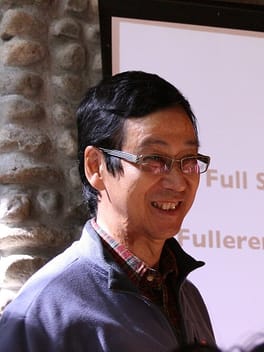
Photo: Topliuchao / CC BY-SA 3.0 (source: Wikimedia Commons)
My Take
Eiichi Nakamura is the kind of scientist who makes you feel like you've wasted your entire life the moment you learn anything about him. Born in Tokyo in 1951, he did postdoctoral research at Columbia University and built a career in chemistry that apparently earned him the Centenary Prize in 2014 — which, for those who don't follow the chemistry awards circuit (so, most of us), is a seriously prestigious recognition from the Royal Society of Chemistry. What I genuinely respect is what the work itself achieved: in 2021 his team released the world's first atomic-scale video of salt crystals forming. Before that he developed reactions with zinc, iron and copper and pioneered fullerene chemistry, decades of quiet, grinding research. He's the archetype of a person who lets the work speak entirely for itself, and in a world drowning in self-promotion, that feels almost radical.
This take was written by generative AI, one per person, from publicly reported facts (editorial policy). It is a reading of the record, not reporting.
Overview
Eiichi Nakamura is a Japanese chemist and researcher born in 1951 in Tokyo, Japan. After a doctorate at the Tokyo Institute of Technology and postdoctoral research at Columbia University, he became a professor at the University of Tokyo. In 2014, he was awarded the Centenary Award in recognition of his contributions to the field.
1. Profile
- Name (English)
- Eiichi Nakamura
- Name (Japanese)
- 中村栄一
- Reading
- なかむら えいいち
- Born
- February 24, 1951 (age 75)
- Origin
- Tokyo, Japan
- Occupation
- Chemist / Researcher
- Zodiac / Chinese zodiac
- Pisces / Rabbit
2. Background
- University
- Columbia University
Awards & achievements
- 2014 — Centenary Award
3. Links
- Wikipedia (Japanese)https://ja.wikipedia.org/wiki/%E4%B8%AD%E6%9D%91%E6%A0%84%E4%B8%80
- Wikidatahttps://www.wikidata.org/wiki/Q3263458
4. About this entry
Tags
- Last updated
Only publicly available facts are listed; non-public or unconfirmed items are omitted. Base data was compiled from Wikidata from June 2026 onward; ages are recalculated daily and deaths are checked against Wikidata on an ongoing basis. English text is machine-assisted (facts translated by Sonnet, "My Take" written by Opus 4.8). The Japanese page is the source of record.
Frequently asked questions
When was Eiichi Nakamura born?
Eiichi Nakamura was born on February 24, 1951 and is 75 years old.
Where is Eiichi Nakamura from?
Eiichi Nakamura is from Tokyo, Japan.
What does Eiichi Nakamura do?
Eiichi Nakamura works as Chemist, Researcher.
Where did Eiichi Nakamura study?
Eiichi Nakamura attended Columbia University.
Chemist — see all → · Researcher — see all → · More people from Japan → · More people born on February 24 →