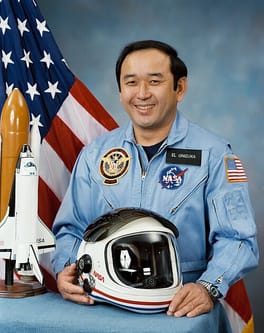
Photo: NASA / Public domain (source: Wikimedia Commons)
Ellison Onizuka, born on June 24, 1946 in Kailua-Kona, Hawaii, United States, was a military officer, astronaut and engineer. Ellison Onizuka died on January 28, 1986 at the age of 39. Schooling on record includes Konawaena High School and University of Colorado. Awards on record include Congressional Space Medal of Honor (2004), NASA Distinguished Service Medal (1986), Eagle Scout and 1 more.
My Take
Ellison Onizuka is one of those figures who makes you stop and feel the full weight of what it means to chase a dream. A Japanese American kid from a small coffee-farming town on the Big Island of Hawaii, he worked his way through aerospace engineering at the University of Colorado, earned his Air Force wings, and then — quietly, without fanfare — became the first Asian American to fly in space on the Discovery mission in 1985. That alone is enormous. He carried an entire community's hopes into orbit and made it look like the most natural thing in the world. When Challenger broke apart on January 28, 1986, the loss was devastating, but the legacy he left behind — honored by the Congressional Space Medal of Honor in 2004 — only grows with time. I think about how an Eagle Scout from Kailua-Kona literally reached the stars, and it genuinely moves me.
This take was written by generative AI, one per person, from publicly reported facts (editorial policy). It is a reading of the record, not reporting.
1. Profile
- Name (English)
- Ellison Onizuka
- Name (Japanese)
- エリソン・オニヅカ
- Reading
- えりそん・おにづか
- Born
- June 24, 1946 – January 28, 1986
- Origin
- Kailua-Kona, Hawaii, United States
- Occupation
- military officer / astronaut / engineer
- Zodiac / Chinese zodiac
- Cancer / Dog
2. Background
- High school
- Konawaena High School
- University
- University of Colorado
Awards & achievements
- 2004 Congressional Space Medal of Honor
- 1986 NASA Distinguished Service Medal
- Eagle Scout
- Meritorious Service Medal
3. Links
4. About this entry
Tags
- Last updated
Facts are limited to publicly available information up to 2024; non-public or unconfirmed items are omitted. English text is machine-assisted (facts translated by Sonnet, "My Take" written by Opus 4.8). The Japanese page is the source of record.
Frequently asked questions
When was Ellison Onizuka born?
Born June 24, 1946.
When did Ellison Onizuka die?
Died January 28, 1986, aged 39.
Where was Ellison Onizuka from?
Ellison Onizuka was from Kailua-Kona, Hawaii, United States.
What did Ellison Onizuka do?
Ellison Onizuka worked as military officer, astronaut, engineer.
Military officer — see all → · Astronaut — see all → · More people from the United States →