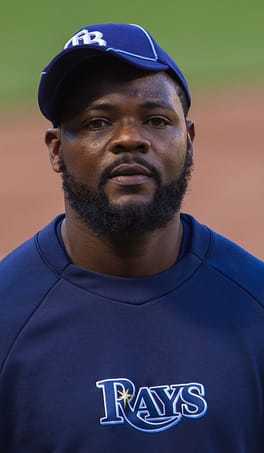
Photo: Keith Allison on Flickr / CC BY-SA 2.0 (source: Wikimedia Commons)
Born on March 18, 1977 in Samaná, Samaná Province, Dominican Republic, Fernando Rodney is a baseball player. As of 2026, Fernando Rodney is 49 years old. The listed height is 180 cm.
My Take
Fernando Rodney is one of baseball's great characters, and the longevity behind the showmanship is what gets me. Born 1977 in Samana, Dominican Republic, the closer with the famously crooked cap and the arrow-into-the-sky celebration pitched for what feels like every team in the majors, the Tigers, Rays, Mariners and many more. Multiple All-Star nods and a fastball that refused to fade with age made him more than a gimmick. I love that he was simultaneously the most fun guy in the bullpen and a genuinely reliable arm in the ninth. Personality plus production is a rare combination, and he had both for ages.
This take was written by generative AI, one per person, from publicly reported facts (editorial policy). It is a reading of the record, not reporting.
1. Profile
- Name (English)
- Fernando Rodney
- Name (Japanese)
- フェルナンド・ロドニー
- Reading
- ふぇるなんど・ろどにー
- Born
- March 18, 1977 (age 49)
- Origin
- Samaná, Samaná Province, Dominican Republic
- Height
- 180 cm
- Occupation
- baseball player
- Zodiac / Chinese zodiac
- Pisces / Snake
2. Links
- Instagramhttps://www.instagram.com/fernandorodney3635/
- Xhttps://x.com/F_Rodney56
- Wikipedia (English)https://en.wikipedia.org/wiki/Fernando%20Rodney
- Wikipedia (Japanese)https://ja.wikipedia.org/wiki/%E3%83%95%E3%82%A7%E3%83%AB%E3%83%8A%E3%83%B3%E3%83%89%E3%83%BB%E3%83%AD%E3%83%89%E3%83%8B%E3%83%BC
- Wikidatahttps://www.wikidata.org/wiki/Q331916
3. About this entry
Tags
- Last updated
Facts are limited to publicly available information up to 2024; non-public or unconfirmed items are omitted. English text is machine-assisted (facts translated by Sonnet, "My Take" written by Opus 4.8). The Japanese page is the source of record.
Frequently asked questions
When was Fernando Rodney born?
Born March 18, 1977 (age 49).
Where is Fernando Rodney from?
Fernando Rodney is from Samaná, Samaná Province, Dominican Republic.
What does Fernando Rodney do?
Fernando Rodney works as baseball player.
How tall is Fernando Rodney?
Fernando Rodney is 180 cm.
Baseball player — see all → · More people from the Dominican Republic →