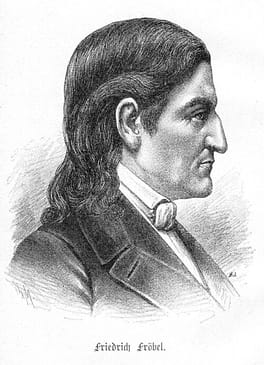
Photo: Verlag A.Pichlers Witwe und Sohn / Public domain (source: Wikimedia Commons)
Friedrich Fröbel was born on April 21, 1782 in Oberweißbach, Thuringia, Germany. Public records list Friedrich Fröbel as a pedagogue, non-fiction writer and teacher. Death is recorded on June 21, 1852, at the age of 70. Education on record includes Friedrich Schiller University Jena.
My Take
Honestly, every time I think about who shaped modern childhood, Friedrich Fröbel is the name that should come up first — and somehow he's still criminally underrated outside education circles. This early-19th-century German thinker looked at children at a time when most adults saw them as small, unfinished workers, and instead declared that play is how kids actually learn — a radical, almost revolutionary idea for 1837. He didn't just write about it; he built the world's first kindergarten in Bad Blankenburg and gave it that name himself. Trained under Pestalozzi and shaped by the forests of Thuringia, he developed hands-on learning tools he called "Gifts" that influenced everyone from Buckminster Fuller to Frank Lloyd Wright. He spent his whole life on this one conviction, died before it fully caught on, and yet today billions of children worldwide walk into a kindergarten every morning without knowing they owe it all to him. That's a legacy.
This take was written by generative AI, one per person, from publicly reported facts (editorial policy). It is a reading of the record, not reporting.
1. Profile
- Name (English)
- Friedrich Fröbel
- Name (Japanese)
- フリードリッヒ・フレーベル
- Reading
- ふりーどりっひ・ふれーべる
- Born
- April 21, 1782 – June 21, 1852
- Origin
- Oberweißbach, Thuringia, Germany
- Occupation
- pedagogue / non-fiction writer / teacher / writer / association football player
- Zodiac / Chinese zodiac
- Taurus / Tiger
2. Background
- University
- Friedrich Schiller University Jena
3. Links
4. About this entry
Tags
- Last updated
Facts are limited to publicly available information up to 2024; non-public or unconfirmed items are omitted. English text is machine-assisted (facts translated by Sonnet, "My Take" written by Opus 4.8). The Japanese page is the source of record.
Frequently asked questions
When was Friedrich Fröbel born?
Born April 21, 1782.
When did Friedrich Fröbel die?
Died June 21, 1852, aged 70.
Where was Friedrich Fröbel from?
Friedrich Fröbel was from Oberweißbach, Thuringia, Germany.
What did Friedrich Fröbel do?
Friedrich Fröbel worked as pedagogue, non-fiction writer, teacher, writer, association football player.
Pedagogue — see all → · Non-fiction writer — see all → · More people from Germany →