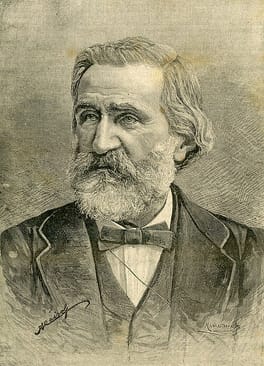
Photo: Disegnatore: A. Cairoli - Incisore: Ernesto Mancastroppa / Public domain (source: Wikimedia Commons)
Born on October 10, 1813, Giuseppe Verdi was from Le Roncole, Province of Parma, Italy. Giuseppe Verdi was a composer, conductor and writer. Death is recorded on January 27, 1901, at the age of 87. Listed accolades include Pour le Mérite for Sciences and Arts order, Knight Grand Cross of the Order of Saints Maurice and Lazarus (1887), Order of Saint Stanislaus (1862) and 5 more. Credited works include La traviata, Rigoletto and Aida.
My Take
Verdi is one of those rare figures whose music outgrew the opera house and became the heartbeat of a nation. What moves me most isn't the staggering list of honors but the way a boy from a tiny village near Parma turned grand opera into something achingly human. The 'Va, pensiero' chorus from Nabucco became an anthem for Italian unification, proof that melody can carry political weight. I admire his relentless work ethic too, composing into his eighties. He didn't just write operas, he gave ordinary people a language for their grief and hope, and that's why he endures.
This take was written by generative AI, one per person, from publicly reported facts (editorial policy). It is a reading of the record, not reporting.
1. Profile
- Name (English)
- Giuseppe Verdi
- Name (Japanese)
- ジュゼッペ・ヴェルディ
- Reading
- じゅぜっぺ・ゔぇるでぃ
- Born
- October 10, 1813 – January 27, 1901
- Origin
- Le Roncole, Province of Parma, Italy
- Occupation
- composer / conductor / writer / politician
- Zodiac / Chinese zodiac
- Libra / Rooster
2. Background
Awards & achievements
- Pour le Mérite for Sciences and Arts order
- 1887 Knight Grand Cross of the Order of Saints Maurice and Lazarus
- 1862 Order of Saint Stanislaus
- 1847 Knight of the Legion of Honour
- 1894 Grand Cross of the Legion of Honour
- Civil Order of Savoy
- Order of the Medjidie
- Knight grand cross of the order of the crown of Italy
3. Works & records
Filmography / notable works
| Category | Title |
|---|---|
| Notable work | La traviata |
| Notable work | Rigoletto |
| Notable work | Aida |
| Notable work | Nabucco |
| Notable work | Il trovatore |
| Notable work | Messa da Requiem |
4. Links
- Official sitehttp://giuseppeverdi.it
- Wikipedia (English)https://en.wikipedia.org/wiki/Giuseppe%20Verdi
- Wikipedia (Japanese)https://ja.wikipedia.org/wiki/%E3%82%B8%E3%83%A5%E3%82%BC%E3%83%83%E3%83%9A%E3%83%BB%E3%83%B4%E3%82%A7%E3%83%AB%E3%83%87%E3%82%A3
- Wikidatahttps://www.wikidata.org/wiki/Q7317
5. About this entry
Tags
- Last updated
Facts are limited to publicly available information up to 2024; non-public or unconfirmed items are omitted. English text is machine-assisted (facts translated by Sonnet, "My Take" written by Opus 4.8). The Japanese page is the source of record.
Frequently asked questions
When was Giuseppe Verdi born?
Giuseppe Verdi was born on October 10, 1813.
When did Giuseppe Verdi die?
Giuseppe Verdi died on January 27, 1901, aged 87.
Where was Giuseppe Verdi from?
Giuseppe Verdi was from Le Roncole, Province of Parma, Italy.
What did Giuseppe Verdi do?
Giuseppe Verdi worked as composer, conductor, writer, politician.
What was Giuseppe Verdi known for?
Giuseppe Verdi's notable works include La traviata, Rigoletto, Aida.
Composer — see all → · Conductor — see all → · More people from Italy → · More people born on October 10 →