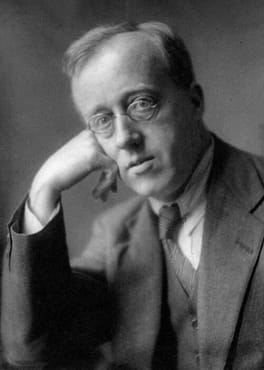
Photo: Herbert Lambert / Public domain (source: Wikimedia Commons)
Born on September 21, 1874 in Cheltenham, United Kingdom, Gustav Holst was a composer, librettist and music teacher. Death is recorded on May 25, 1934, at the age of 59. Gustav Holst studied at University College London. Listed accolades include Royal Philharmonic Society Gold Medal (1930). Credited works include The Planets and In the Bleak Midwinter.
My Take
Gustav Holst is, for me, the rare composer defined by a single colossal achievement. The Planets is so vivid that Mars and Jupiter have lodged themselves permanently in our collective ear, influencing film scores for a century. He reportedly felt ambivalent that nothing else he wrote matched its fame, and I find that tension poignant. But I'd argue that writing one work that becomes part of humanity's shared imagination is a triumph most artists never approach. This Cheltenham-born Englishman had a mystic streak and a teacher's heart, and Jupiter's grand central melody still gives me chills every single time.
This take was written by generative AI, one per person, from publicly reported facts (editorial policy). It is a reading of the record, not reporting.
1. Profile
- Name (English)
- Gustav Holst
- Name (Japanese)
- グスターヴ・ホルスト
- Reading
- ぐすたーゔ・ほるすと
- Born
- September 21, 1874 – May 25, 1934
- Origin
- Cheltenham, United Kingdom
- Occupation
- composer / librettist / music teacher / conductor / music arranger
- Zodiac / Chinese zodiac
- Virgo / Dog
2. Background
- University
- University College London
Awards & achievements
- 1930 Royal Philharmonic Society Gold Medal
3. Works & records
Filmography / notable works
| Category | Title |
|---|---|
| Notable work | The Planets |
| Notable work | In the Bleak Midwinter |
4. Links
5. About this entry
Tags
- Last updated
Facts are limited to publicly available information up to 2024; non-public or unconfirmed items are omitted. English text is machine-assisted (facts translated by Sonnet, "My Take" written by Opus 4.8). The Japanese page is the source of record.
Frequently asked questions
When was Gustav Holst born?
Gustav Holst was born on September 21, 1874.
When did Gustav Holst die?
Gustav Holst died on May 25, 1934, aged 59.
Where was Gustav Holst from?
Gustav Holst was from Cheltenham, United Kingdom.
What did Gustav Holst do?
Gustav Holst worked as composer, librettist, music teacher, conductor, music arranger.
Where did Gustav Holst study?
Gustav Holst attended University College London.
What was Gustav Holst known for?
Gustav Holst's notable works include The Planets, In the Bleak Midwinter.
Composer — see all → · Librettist — see all → · More people from the United Kingdom → · More people born on September 21 →