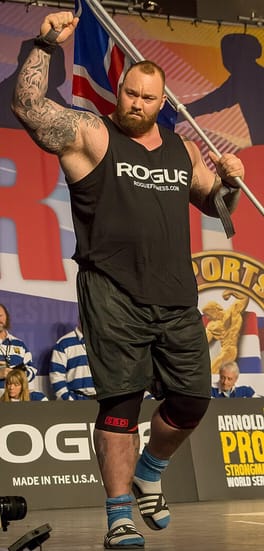
Photo: Paula R. Lively from Zanesville / CC BY 2.0 (source: Wikimedia Commons)
Born on November 26, 1988 in Iceland, Hafþór Júlíus Björnsson is a basketball player, television actor and film actor. That puts Hafþór Júlíus Björnsson at 37 years old in 2026. The listed height is 206 cm.
My Take
What fascinates me about Hafþór isn't the 130 world records, staggering as they are — it's the intelligence behind the strength. He started as a basketball player, transitioned into strongman competition, and then conquered acting as television's most memorable giant. That's three careers most people couldn't manage one of. I think the long Icelandic winters bred a patience you can see in how he builds toward a lift: methodical, almost serene, until the explosion. He turned raw mass into a brand without ever seeming cynical about it. Among strength athletes, he's the rare one whose charisma matches his physique, and I find myself rooting for whatever he tries next.
This take was written by generative AI, one per person, from publicly reported facts (editorial policy). It is a reading of the record, not reporting.
1. Profile
- Name (English)
- Hafþór Júlíus Björnsson
- Name (Japanese)
- ハフソー・ユリウス・ビョルンソン
- Reading
- はふそー・ゆりうす・びょるんそん
- Born
- November 26, 1988 (age 37)
- Origin
- Iceland
- Height
- 206 cm
- Occupation
- basketball player / television actor / film actor / strongman / powerlifter
- Zodiac / Chinese zodiac
- Sagittarius / Dragon
2. Links
- Official sitehttp://hafthorbjornsson.com/
- Instagramhttps://www.instagram.com/thorbjornsson/
- Xhttps://x.com/thorbjornsson_
- Wikipedia (English)https://en.wikipedia.org/wiki/Haf%C3%BE%C3%B3r%20J%C3%BAl%C3%ADus%20Bj%C3%B6rnsson
- Wikipedia (Japanese)https://ja.wikipedia.org/wiki/%E3%83%8F%E3%83%95%E3%82%BD%E3%83%BC%E3%83%BB%E3%83%A6%E3%83%AA%E3%82%A6%E3%82%B9%E3%83%BB%E3%83%93%E3%83%A7%E3%83%AB%E3%83%B3%E3%82%BD%E3%83%B3
- Wikidatahttps://www.wikidata.org/wiki/Q5638484
3. About this entry
Tags
- Last updated
Facts are limited to publicly available information up to 2024; non-public or unconfirmed items are omitted. English text is machine-assisted (facts translated by Sonnet, "My Take" written by Opus 4.8). The Japanese page is the source of record.
Frequently asked questions
When was Hafþór Júlíus Björnsson born?
Born November 26, 1988 (age 37).
Where is Hafþór Júlíus Björnsson from?
Hafþór Júlíus Björnsson is from Iceland.
What does Hafþór Júlíus Björnsson do?
Hafþór Júlíus Björnsson works as basketball player, television actor, film actor, strongman, powerlifter.
How tall is Hafþór Júlíus Björnsson?
Hafþór Júlíus Björnsson is 206 cm.
Basketball player — see all → · Television actor — see all → · More people from Iceland →