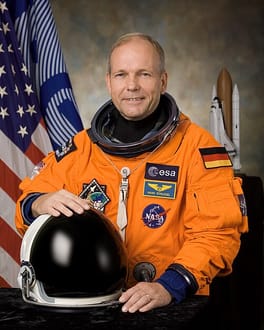
Photo: NASA / Public domain (source: Wikimedia Commons)
Born on August 3, 1951 in Überlingen, Tübingen Government Region, Germany, Hans Schlegel is an astronaut and physicist. As of 2026, Hans Schlegel is 75 years old. Education on record includes Lewis Central High School and RWTH Aachen University. Awards on record include Officer's Cross of the Order of Merit of the Federal Republic of Germany and Order of Friendship.
My Take
Hans Schlegel sits in a category I find genuinely awe-inspiring. A trained physicist from RWTH Aachen who flew two Space Shuttle missions, he belongs to the tiny club of humans who have actually looked back at Earth from orbit. What gets me is the dual nature required: the cold precision of physics and the raw nerve to risk your life in zero gravity. Being decorated by both Germany and Russia hints at a man whose ambition transcended borders. Most of us only gaze at the night sky; Schlegel went and stood beside the stars, and that scale of dream humbles me.
This take was written by generative AI, one per person, from publicly reported facts (editorial policy). It is a reading of the record, not reporting.
1. Profile
- Name (English)
- Hans Schlegel
- Name (Japanese)
- ハンス・シュリーゲル
- Reading
- はんす・しゅりーげる
- Born
- August 3, 1951 (age 75)
- Origin
- Überlingen, Tübingen Government Region, Germany
- Occupation
- astronaut / physicist
- Zodiac / Chinese zodiac
- Leo / Rabbit
2. Background
- High school
- Lewis Central High School
- University
- RWTH Aachen University
Awards & achievements
- Officer's Cross of the Order of Merit of the Federal Republic of Germany
- Order of Friendship
3. Links
4. About this entry
Tags
- Last updated
Facts are limited to publicly available information up to 2024; non-public or unconfirmed items are omitted. English text is machine-assisted (facts translated by Sonnet, "My Take" written by Opus 4.8). The Japanese page is the source of record.
Frequently asked questions
When was Hans Schlegel born?
Born August 3, 1951 (age 75).
Where is Hans Schlegel from?
Hans Schlegel is from Überlingen, Tübingen Government Region, Germany.
What does Hans Schlegel do?
Hans Schlegel works as astronaut, physicist.
Astronaut — see all → · Physicist — see all → · More people from Germany →