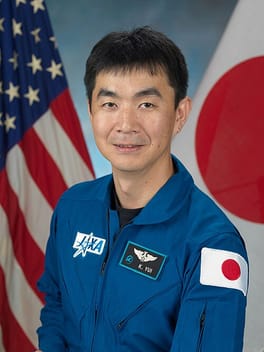
Photo: NASA / Public domain (source: Wikimedia Commons)
My Take
I love that this guy grew up in Kawakami in Nagano and then actually went and flew off into space, twice. From the National Defense Academy to a fighter cockpit in the Air Self-Defense Force to JAXA and a stint living on the International Space Station, his whole arc reads like a kid's dream that somebody refused to put down. That mix of feet-on-the-ground steadiness and wide-eyed curiosity is exactly the kind of person you want carrying a country's hopes upward. Honestly, watching someone like him makes me a little proud too.
This take was written by generative AI, one per person, from publicly reported facts (editorial policy). It is a reading of the record, not reporting.
Overview
Kimiya Yui is a Japanese astronaut and former Japan Air Self-Defense Force pilot, born on January 30, 1970, in Kawakami Village, Nagano Prefecture. He graduated from the National Defense Academy of Japan and went on to serve as a fighter pilot before being selected as a JAXA astronaut. He has flown two long-duration missions to the International Space Station, on Soyuz TMA-17M in 2015 and SpaceX Crew-11 in 2025.
1. Profile
- Name (English)
- Kimiya Yui
- Name (Japanese)
- 油井亀美也
- Reading
- ゆい きみや
- Born
- January 30, 1970 (age 56)
- Origin
- Kawakami Village, Nagano Prefecture, Japan
- Occupation
- Astronaut / Japan Air Self-Defense Force Officer
- Zodiac / Chinese zodiac
- Aquarius / Dog
2. Background
- University
- National Defense Academy of Japan
3. Links
4. About this entry
Tags
- Last updated
Only publicly available facts are listed; non-public or unconfirmed items are omitted. Base data was compiled from Wikidata from June 2026 onward; ages are recalculated daily and deaths are checked against Wikidata on an ongoing basis. English text is machine-assisted (facts translated by Sonnet, "My Take" written by Opus 4.8). The Japanese page is the source of record.
Frequently asked questions
When was Kimiya Yui born?
Kimiya Yui was born on January 30, 1970 and is 56 years old.
Where is Kimiya Yui from?
Kimiya Yui is from Kawakami Village, Nagano Prefecture, Japan.
What does Kimiya Yui do?
Kimiya Yui works as Astronaut, Japan Air Self-Defense Force Officer.
Where did Kimiya Yui study?
Kimiya Yui attended National Defense Academy of Japan.
Astronaut — see all → · More people from Japan → · More people born on January 30 →