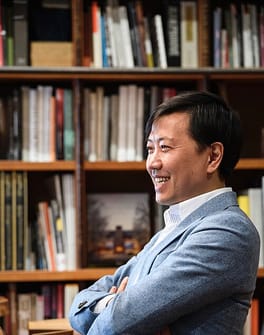
Photo: KEI Tanaka / CC BY-SA 4.0 (source: Wikimedia Commons)
My Take
Hiroshi Nakamura is the kind of architect who makes you forget you're inside a building — and I mean that as the highest possible compliment. Born in Tokyo in 1974 and trained at Meiji University's engineering school, he came up in an era when Japanese architecture was swinging between cold high-tech minimalism and postmodern noise, and he quietly carved out a third path: structures that breathe, that use wood and natural light like ingredients rather than afterthoughts. His firm NAP Architects has produced work that feels almost shy about being architecture at all — curved timber, dappled shadow, spaces that seem to want you to slow down. He's not the type to dominate magazine covers or give TED talks, which honestly makes me trust him more. There's something quietly radical about a person whose life's argument is made entirely in wood and concrete, still standing long after the conversation ends.
This take was written by generative AI, one per person, from publicly reported facts (editorial policy). It is a reading of the record, not reporting.
Overview
Hiroshi Nakamura (born February 12, 1974, in Tokyo) is a Japanese architect. He studied at the Faculty of Science and Technology at Meiji University. He is known for his work in architecture, with a focus that has drawn attention in Japan. Most details of his personal life remain private.
1. Profile
- Name (English)
- Hiroshi Nakamura
- Name (Japanese)
- 中村拓志
- Reading
- なかむら ひろし
- Born
- February 12, 1974 (age 52)
- Origin
- Tokyo, Japan
- Occupation
- Architect
- Zodiac / Chinese zodiac
- Aquarius / Tiger
2. Background
- University
- Meiji University, Faculty of Science and Technology
3. Links
- Wikipedia (Japanese)https://ja.wikipedia.org/wiki/%E4%B8%AD%E6%9D%91%E6%8B%93%E5%BF%97
- Wikidatahttps://www.wikidata.org/wiki/Q11365628
4. About this entry
Tags
- Last updated
Facts are limited to publicly available information up to 2024; non-public or unconfirmed items are omitted. English text is machine-assisted (facts translated by Sonnet, "My Take" written by Opus 4.8). The Japanese page is the source of record.
Frequently asked questions
When was Hiroshi Nakamura born?
Born February 12, 1974 (age 52).
Where is Hiroshi Nakamura from?
Hiroshi Nakamura is from Tokyo, Japan.
What does Hiroshi Nakamura do?
Hiroshi Nakamura works as Architect.