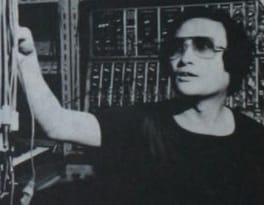
Photo: Unknown photographer / Public domain (source: Wikimedia Commons)
My Take
I have a real soft spot for Isao Tomita, the kind of artist who makes me believe in quiet, obsessive genius. Picture a Keio-educated Tokyo guy, born back in 1932, hunched over one of those enormous early Moog modular synths and patiently rewiring Debussy's "Clair de Lune" into something that sounds like moonlight drifting through deep space. That 1974 album "Snowflakes Are Dancing" still gives me chills, because he wasn't just slapping bleeps on classical melodies, he was reimagining the whole color of the sound. He scored anime too, like the sweeping "Jungle Emperor" theme, then poured years into ambitious projects woven around "The Tale of Genji." No flashy ego, just a craftsman married to his machines. He passed in 2016, but those crystalline electronic tones feel timeless to me.
This take was written by generative AI, one per person, from publicly reported facts (editorial policy). It is a reading of the record, not reporting.
Overview
Isao Tomita (April 22, 1932 – May 5, 2016) was a Japanese composer born in Suginami, Tokyo, who became internationally recognized as a trailblazer of synthesizer and electronic music. A graduate of Keio University, he began his career writing orchestral film and television scores before turning to elaborate synthesizer arrangements that introduced Western classical works to a new sonic dimension. He is best known for his electronic rendition of Debussy's Clair de Lune, the grand orchestral fantasy Genji Monogatari Gensō Kōkyō Ezu, and the sweeping score for the anime Kimba the White Lion. He was awarded the Order of the Rising Sun, Fourth Class, with Small Ribbon.
1. Profile
- Name (English)
- Isao Tomita
- Name (Japanese)
- 冨田勲
- Reading
- とみた いさお
- Born
- April 22, 1932 – May 5, 2016
- Origin
- Suginami, Tokyo, Japan
- Occupation
- Composer / Keyboardist / Film and TV score composer / Recording artist / Arranger
- Zodiac / Chinese zodiac
- Taurus / Monkey
- Active years
- 1952 - 2016
2. Background
- University
- Keio University
Awards & achievements
- Order of the Rising Sun, Fourth Class, with Small Ribbon (year unknown)
3. Works & records
Works summary
- Works
- 526 (1951–2019)
- By year (titles with a known year)
- 1951: 1, 1952: 1, 1954: 2, 1955: 3, 1956: 8, 1957: 4, 1958: 9, 1959: 14, 1960: 7, 1961: 9, 1962: 8, 1963: 8, 1964: 11, 1965: 20, 1966: 4, 1967: 6, 1968: 18, 1969: 16, 1970: 22, 1971: 20, 1972: 23, 1973: 27, 1974: 16, 1975: 1, 1976: 3, 1977: 3, 1978: 6, 1979: 5, 1980: 2, 1981: 5, 1982: 4, 1983: 3, 1984: 2, 1985: 4, 1987: 2, 1988: 3, 1989: 3, 1990: 2, 1991: 2, 1992: 7, 1993: 2, 1994: 5, 1995: 4, 1996: 3, 1997: 9, 1998: 5, 1999: 6, 2000: 1, 2001: 3, 2002: 8, 2003: 3, 2004: 4, 2005: 7, 2006: 3, 2007: 5, 2008: 3, 2009: 1, 2010: 1, 2011: 4, 2012: 4, 2013: 1, 2014: 1, 2015: 3, 2016: 25, 2017: 2, 2018: 4, 2019: 3, year unknown: 92
- Debut work
- 森永エンゼルタイム
Filmography / notable works
| Category | Title |
|---|---|
| Representative work | Genji Monogatari Gensō Kōkyō Ezu |
| Representative work | Clair de Lune |
| Representative work | Symphonic Poem Kimba the White Lion |
4. Links
- Official sitehttps://www.isaotomita.net/
- Wikipedia (Japanese)https://ja.wikipedia.org/wiki/%E5%86%A8%E7%94%B0%E5%8B%B2
- Wikidatahttps://www.wikidata.org/wiki/Q546592
5. About this entry
Tags
- Last updated
Only publicly available facts are listed; non-public or unconfirmed items are omitted. Base data was compiled from Wikidata from June 2026 onward; ages are recalculated daily and deaths are checked against Wikidata on an ongoing basis. Works and profile fields sourced from Wikipedia reflect content as of 2026-08-26. English text is machine-assisted (facts translated by Sonnet, "My Take" written by Opus 4.8). The Japanese page is the source of record.
Frequently asked questions
When was Isao Tomita born?
Isao Tomita was born on April 22, 1932.
When did Isao Tomita die?
Isao Tomita died on May 5, 2016, aged 84.
Where was Isao Tomita from?
Isao Tomita was from Suginami, Tokyo, Japan.
What did Isao Tomita do?
Isao Tomita worked as Composer, Keyboardist, Film and TV score composer, Recording artist, Arranger.
Where did Isao Tomita study?
Isao Tomita attended Keio University.
When was Isao Tomita active?
Isao Tomita was active from 1952 to 2016.
What was Isao Tomita known for?
Isao Tomita's notable works include Genji Monogatari Gensō Kōkyō Ezu, Clair de Lune, Symphonic Poem Kimba the White Lion.
Composer — see all → · Keyboardist — see all → · More people from Japan → · More people born on April 22 →