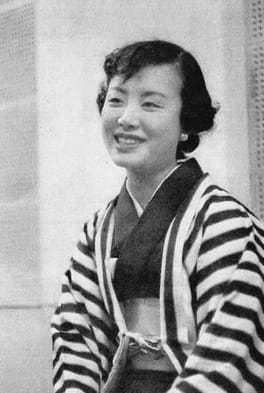
Photo: Unknown author / Public domain (source: Wikimedia Commons)
My Take
Okay, picture an eleven-year-old kid stepping up to a microphone and flat-out commanding a room full of grown adults, and you start to get why people still talk about Hibari Misora like she's a force of nature. To me she isn't really a singer you compare to others, she's basically her own genre, that voice doing things with phrasing and emotion that nobody taught her and nobody's quite replicated since. Songs like Ringo Oiwake or Kanashii Sake will sneak up and wreck you even when you've got zero reason to feel sad, which is honestly a little unfair. And the fact that she gave us Kawa no Nagare no You ni right at the end, basically singing the whole Showa era out the door, just floors me. I'd happily lose an evening arguing she's untouchable.
This take was written by generative AI, one per person, from publicly reported facts (editorial policy). It is a reading of the record, not reporting.
Story
The Girl Who Was Given Only the Gift of Song: Hibari Misora and the Showa Era She Sang to a Close
Overview
Hibari Misora (born Kazue Kato; May 29, 1937 – June 24, 1989) was a Japanese singer and actress from Isogo, Yokohama, Kanagawa, widely regarded as the queen of Japanese popular music. She made her recording debut at age eleven in 1949 with "Kappa Boogie-Woogie" and became a national star the following year through her lead role and theme song in the film "Kanashiki Kuchibue." Over a career spanning more than four decades, she won the Japan Record Award Grand Prix in 1965 and released her best-known song "Kawa no Nagare no You ni" in 1988; after her death at age 52 she was posthumously awarded the People's Honor Award, the first woman to receive the distinction.
1. Profile
- Name (English)
- Hibari Misora
- Name (Japanese)
- 美空ひばり
- Reading
- みそら ひばり
- Born
- May 29, 1937 – June 24, 1989
- Origin
- Isogo, Yokohama, Kanagawa, Japan
- Height
- 155 cm
- Occupation
- Singer / Actress
- Zodiac / Chinese zodiac
- Gemini / Ox
- Blood type
- O
- Agency
- Hibari Production
- Agency history
- Nippon Columbia (exclusive record label)
Shochiku (film)
Toei (exclusive film contract, from 1958) - Active years
- 1945–1989
2. Background
- Elementary school
- Yokohama Municipal Takigashira Elementary School
- Junior high
- Seika Gakuen Girls' Junior High School
- High school
- Seika Gakuen Girls' High School
- University
- Did not attend university
- Debut
- 1949 — appeared in the film "Odoru Ryugujo" and made her recording debut with "Kappa Boogie-Woogie" at age 11
Awards & achievements
- 1960 Japan Record Award — Vocal Award (Aishuu Hatoba)
- 1965 Japan Record Award — Grand Prix (Judo)
- 1973 Japan Record Award — 15th Anniversary Special Award
- 1976 Japan Record Award — Special Award
- 1989 Japan Record Award — Special Honor Singer Award (Kawa no Nagare no You ni)
- 1989 People's Honor Award (posthumous; first woman recipient)
Timeline
- 1937Born on May 29 in Takigashira, Isogo, Yokohama, Kanagawa; birth name Kazue Kato
- 1945Made her stage debut with her father's Aozora Orchestra under the stage name Kazue Misora
- 1949Appeared in the film Odoru Ryugujo and made her recording debut with "Kappa Boogie-Woogie" at age 11
- 1950Starred in the film Kanashiki Kuchibue; its theme song sold 450,000 copies, making her a national star
- 1958Signed an exclusive film contract with Toei and appeared in numerous period dramas
- 1962Entered a common-law relationship with actor Akira Kobayashi (no formal marriage registration)
- 1964Separated from Akira Kobayashi
- 1965Won the Japan Record Award Grand Prix for "Judo"
- 1988Released "Kawa no Nagare no You ni," which sold over two million copies
- 1989Died on June 24 from respiratory failure due to idiopathic interstitial pneumonia, aged 52; posthumously received the People's Honor Award — the first woman to do so
3. Relationships
- Spouse
- Akira Kobayashi (common-law relationship 1962–1964; no formal registration)
- Children
- Adopted son Kazuya Kato (son of her younger brother Tetsuya Kato, adopted)
- Parents
- Father: Masukichi Kato (fishmonger); Mother: Kimie Kato
- Siblings
- Younger sister Setsuko; younger brothers Masuo and Takehiko (later known as Tetsuya Kato)
4. Personality
Specialties
- Singing
- Shamisen
- Japanese dance
5. Works & records
Works summary
- Appearances
- 765 (1950–2026)
- By year
- 1950: 20, 1951: 21, 1952: 21, 1953: 27, 1954: 30, 1955: 34, 1956: 26, 1957: 30, 1958: 39, 1959: 33, 1960: 20, 1961: 26, 1962: 26, 1963: 23, 1964: 23, 1965: 17, 1966: 19, 1967: 10, 1968: 14, 1969: 16, 1970: 21, 1971: 10, 1972: 7, 1973: 7, 1974: 8, 1975: 10, 1976: 9, 1977: 3, 1978: 9, 1979: 5, 1980: 6, 1981: 4, 1982: 3, 1983: 6, 1984: 4, 1985: 4, 1986: 7, 1987: 4, 1988: 4, 1989: 14, 1990: 5, 1991: 26, 1992: 1, 1996: 2, 1999: 2, 2001: 3, 2002: 1, 2003: 12, 2004: 3, 2005: 1, 2006: 3, 2007: 3, 2008: 3, 2009: 3, 2010: 4, 2011: 3, 2012: 2, 2013: 4, 2014: 5, 2015: 5, 2016: 4, 2017: 3, 2018: 1, 2019: 3, 2020: 2, 2021: 1, 2022: 2, 2023: 2, 2024: 1, 2025: 1, 2026: 2
- Debut work
- ヒットパレード
Filmography / notable works
| Category | Title | Role | Year |
|---|---|---|---|
| Song | Kappa Boogie-Woogie | Vocalist | 1949 |
| Song | Kanashiki Kuchibue | Vocalist | 1949 |
| Song | Ringo Oiwake | Vocalist | 1952 |
| Song | Judo | Vocalist | 1964 |
| Song | Kanashii Sake | Vocalist | 1966 |
| Song | Ai Sansan | Vocalist | 1986 |
| Song | Kawa no Nagare no You ni | Vocalist | 1989 |
| Film | Kanashiki Kuchibue | Lead | 1949 |
| Film | Tokyo Kid | Lead | 1950 |
| Film | Hibari Torimoncho: Furisode Koban | Lead | 1958 |
6. Links
- Official sitehttps://www.misorahibari.com/
- Wikipedia (Japanese)https://ja.wikipedia.org/wiki/%E7%BE%8E%E7%A9%BA%E3%81%B2%E3%81%B0%E3%82%8A
- Wikidatahttps://www.wikidata.org/wiki/Q147811
7. About this entry
Tags
- Last updated
Facts are limited to publicly available information up to 2024; non-public or unconfirmed items are omitted. Works and profile fields sourced from Wikipedia reflect content as of 2026-08-26. English text is machine-assisted (facts translated by Sonnet, "My Take" written by Opus 4.8). The Japanese page is the source of record.
Frequently asked questions
When was Hibari Misora born?
Born May 29, 1937.
When did Hibari Misora die?
Died June 24, 1989, aged 52.
Where was Hibari Misora from?
Hibari Misora was from Isogo, Yokohama, Kanagawa, Japan.
What did Hibari Misora do?
Hibari Misora worked as Singer, Actress.
How tall was Hibari Misora?
Hibari Misora was 155 cm.
What was Hibari Misora's blood type?
O.
What agency was Hibari Misora with?
Hibari Misora was with Hibari Production.
When was Hibari Misora active?
1945–1989.
What was Hibari Misora known for?
Notable works include Kappa Boogie-Woogie, Kanashiki Kuchibue, Ringo Oiwake.
Singer — see all → · Actress — see all → · More people from Japan →