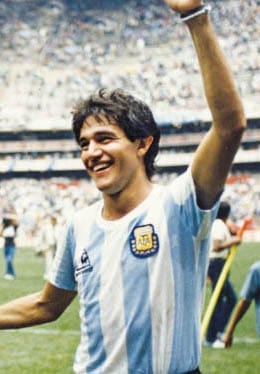
Photo: Unknown author / Public domain (source: Wikimedia Commons)
Jorge Burruchaga was born on October 9, 1962 in Gualeguay, Entre Ríos Province, Argentina and is credited as an association football player and association football coach. Jorge Burruchaga is 63 years old as of 2026. The listed height is 176 cm.
My Take
For me, Jorge Burruchaga will always be defined by a single sprint. He scored the winning goal in the 1986 World Cup final, the kind of moment that fixes a footballer in collective memory forever. What I appreciate, though, is that he wasn't just a finisher; the records describe him as an attacking midfielder as much as a forward, the connective player who makes the famous goals possible. The nickname Burru fits that unfussy, working profile. He later moved into coaching, which tells me the game stayed in him well past his playing days. A career that peaked on the biggest stage imaginable.
This take was written by generative AI, one per person, from publicly reported facts (editorial policy). It is a reading of the record, not reporting.
1. Profile
- Name (English)
- Jorge Burruchaga
- Name (Japanese)
- ホルヘ・ブルチャガ
- Reading
- ほるへ・ぶるちゃが
- Born
- October 9, 1962 (age 63)
- Origin
- Gualeguay, Entre Ríos Province, Argentina
- Height
- 176 cm
- Occupation
- association football player / association football coach
- Zodiac / Chinese zodiac
- Libra / Tiger
2. Links
3. About this entry
Tags
- Last updated
Facts are limited to publicly available information up to 2024; non-public or unconfirmed items are omitted. English text is machine-assisted (facts translated by Sonnet, "My Take" written by Opus 4.8). The Japanese page is the source of record.
Frequently asked questions
When was Jorge Burruchaga born?
Born October 9, 1962 (age 63).
Where is Jorge Burruchaga from?
Jorge Burruchaga is from Gualeguay, Entre Ríos Province, Argentina.
What does Jorge Burruchaga do?
Jorge Burruchaga works as association football player, association football coach.
How tall is Jorge Burruchaga?
Jorge Burruchaga is 176 cm.
Association football player — see all → · Association football coach — see all → · More people from Argentina →