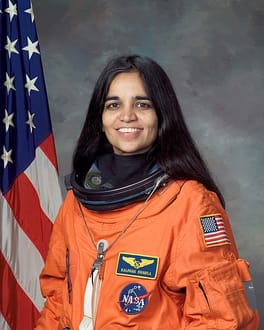
Photo: NASA / Public domain (source: Wikimedia Commons)
Kalpana Chawla, born on March 17, 1962 in Karnal, Haryana, India, was a military flight engineer, astronaut and amateur radio operator. Kalpana Chawla died on February 1, 2003, aged 40. Education on record includes Punjab Engineering College. Awards on record include Congressional Space Medal of Honor (2004), Order of Merit (Ukraine), 3rd class, NASA Space Flight Medal and 1 more.
My Take
Kalpana Chawla is one of those figures who genuinely makes you stop and think about what it takes to chase a dream across continents and atmospheres. Born in Karnal, India, she earned her engineering chops at Punjab Engineering College before making her way to the United States, eventually becoming NASA's first woman of Indian origin to reach space — a fact that still carries enormous weight. She flew her first mission aboard the Space Shuttle Columbia in 1997, and when she returned for her second flight in 2003, she never came home. The Columbia disaster took her and six crewmates on February 1st of that year. What strikes me most is how completely she embodied the idea that ambition has no borders — the Congressional Space Medal of Honor awarded posthumously in 2004 only scratches the surface of what she meant to a generation of South Asian kids who suddenly saw themselves in the stars.
This take was written by generative AI, one per person, from publicly reported facts (editorial policy). It is a reading of the record, not reporting.
1. Profile
- Name (English)
- Kalpana Chawla
- Name (Japanese)
- カルパナ・チャウラ
- Reading
- かるぱな・ちゃうら
- Born
- March 17, 1962 – February 1, 2003
- Origin
- Karnal, Haryana, India
- Occupation
- military flight engineer / astronaut / amateur radio operator
- Zodiac / Chinese zodiac
- Pisces / Tiger
2. Background
- University
- Punjab Engineering College
Awards & achievements
- 2004 Congressional Space Medal of Honor
- Order of Merit (Ukraine), 3rd class
- NASA Space Flight Medal
- 2003 NASA Distinguished Service Medal
3. Links
4. About this entry
Tags
- Last updated
Only publicly available facts are listed; non-public or unconfirmed items are omitted. Base data was compiled from Wikidata from June 2026 onward; ages are recalculated daily and deaths are checked against Wikidata on an ongoing basis. English text is machine-assisted (facts translated by Sonnet, "My Take" written by Opus 4.8). The Japanese page is the source of record.
Frequently asked questions
When was Kalpana Chawla born?
Kalpana Chawla was born on March 17, 1962.
When did Kalpana Chawla die?
Kalpana Chawla died on February 1, 2003, aged 40.
Where was Kalpana Chawla from?
Kalpana Chawla was from Karnal, Haryana, India.
What did Kalpana Chawla do?
Kalpana Chawla worked as military flight engineer, astronaut, amateur radio operator.
Where did Kalpana Chawla study?
Kalpana Chawla attended Punjab Engineering College.
Military flight engineer — see all → · Astronaut — see all → · More people from India → · More people born on March 17 →