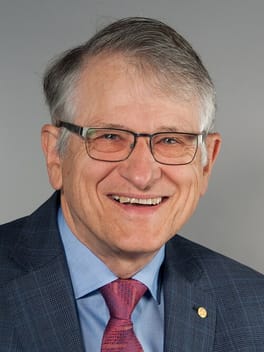
Photo: Pontifical Academy of Sciences / CC BY-SA 4.0 (source: Wikimedia Commons)
Born on June 28, 1943 in Środa Wielkopolska, Greater Poland Voivodeship, Poland, Klaus von Klitzing is a physicist and university teacher. That puts Klaus von Klitzing at 83 years old in 2026. Education on record includes University of Würzburg. Recorded honors include Order of Merit of Baden-Württemberg (1986), Great Cross with Star and Sash of the Order of Merit of the Federal Republic of Germany, Nobel Prize in Physics (1985) and 5 more.
My Take
Klaus von Klitzing belongs to that rare group whose discovery quietly reshaped the world. His integer quantum Hall effect didn't just win the 1985 Nobel Prize; it gave us a way to define electrical resistance with near-perfect precision, turning a deep quantum truth into a practical standard the whole planet relies on. Born in what is now Poland and forged in German research labs, he stacked up honor after honor without ever feeling like a showman. I'm no physicist, but I find something humbling about a mind that can spot such clean order hidden in nature. He earns my unreserved respect.
This take was written by generative AI, one per person, from publicly reported facts (editorial policy). It is a reading of the record, not reporting.
1. Profile
- Name (English)
- Klaus von Klitzing
- Name (Japanese)
- クラウス・フォン・クリッツィング
- Reading
- くらうす・ふぉん・くりっつぃんぐ
- Born
- June 28, 1943 (age 83)
- Origin
- Środa Wielkopolska, Greater Poland Voivodeship, Poland
- Occupation
- physicist / university teacher
- Zodiac / Chinese zodiac
- Cancer / Goat
2. Background
- University
- University of Würzburg
Awards & achievements
- 1986 Order of Merit of Baden-Württemberg
- Great Cross with Star and Sash of the Order of Merit of the Federal Republic of Germany
- 1985 Nobel Prize in Physics
- 1988 Bavarian Maximilian Order for Science and Art
- 1981 Walter Schottky Prize
- 1988 Dirac Medal for the Advancement of Physics
- 2005 Carl Friedrich Gauss Medal
- 2013 Hall of Fame of German Research
3. Links
- Wikipedia (English)https://en.wikipedia.org/wiki/Klaus%20von%20Klitzing
- Wikipedia (Japanese)https://ja.wikipedia.org/wiki/%E3%82%AF%E3%83%A9%E3%82%A6%E3%82%B9%E3%83%BB%E3%83%95%E3%82%A9%E3%83%B3%E3%83%BB%E3%82%AF%E3%83%AA%E3%83%83%E3%83%84%E3%82%A3%E3%83%B3%E3%82%B0
- Wikidatahttps://www.wikidata.org/wiki/Q71024
4. About this entry
Tags
- Last updated
Facts are limited to publicly available information up to 2024; non-public or unconfirmed items are omitted. English text is machine-assisted (facts translated by Sonnet, "My Take" written by Opus 4.8). The Japanese page is the source of record.
Frequently asked questions
When was Klaus von Klitzing born?
Born June 28, 1943 (age 83).
Where is Klaus von Klitzing from?
Klaus von Klitzing is from Środa Wielkopolska, Greater Poland Voivodeship, Poland.
What does Klaus von Klitzing do?
Klaus von Klitzing works as physicist, university teacher.
Physicist — see all → · University teacher — see all → · More people from Poland →