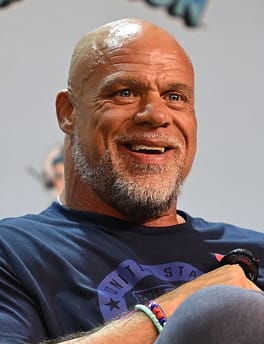
Photo: Super Festivals from Ft. Lauderdale, USA / CC BY 2.0 (source: Wikimedia Commons)
Kurt Angle was born on December 9, 1968 in Mt. Lebanon, Pennsylvania, United States. Kurt Angle is a professional wrestler, amateur wrestler and sports commentator. That works out to 57 years old in 2026. Schooling on record includes Mt. Lebanon High School. Listed accolades include WWE Hall of Fame and Wrestling Observer Newsletter Hall of Fame.
My Take
Kurt Angle might be the most legitimately impressive person to ever lace up wrestling boots, and I mean that sincerely. This is a guy from a small Pittsburgh suburb who won an Olympic gold medal in freestyle wrestling at the 1996 Atlanta Games — and did it with a broken neck, which is the kind of detail that sounds made up but absolutely isn't. Then he walked into WWE and, instead of coasting on that credibility, actually became one of the greatest in-ring performers of his generation, earning a Hall of Fame induction on pure merit. The "you suck" chants that became a crowd ritual were almost a term of endearment — fans knew they were watching someone elite. He could make any opponent look good, carry a comedic promo, and then go out and have a legitimate five-star match. That combination of real athletic pedigree and pro wrestling instinct is genuinely rare, and Angle had both in abundance.
This take was written by generative AI, one per person, from publicly reported facts (editorial policy). It is a reading of the record, not reporting.
1. Profile
- Name (English)
- Kurt Angle
- Name (Japanese)
- カート・アングル
- Reading
- かーと・あんぐる
- Born
- December 9, 1968 (age 57)
- Origin
- Mt. Lebanon, Pennsylvania, United States
- Occupation
- professional wrestler / amateur wrestler / sports commentator / musician
- Zodiac / Chinese zodiac
- Sagittarius / Monkey
2. Background
- High school
- Mt. Lebanon High School
Awards & achievements
- WWE Hall of Fame
- Wrestling Observer Newsletter Hall of Fame
3. Links
- Official sitehttps://kurtanglebrand.com/
- Instagramhttps://www.instagram.com/therealkurtangle/
- Xhttps://x.com/RealKurtAngle
- Wikipedia (English)https://en.wikipedia.org/wiki/Kurt%20Angle
- Wikipedia (Japanese)https://ja.wikipedia.org/wiki/%E3%82%AB%E3%83%BC%E3%83%88%E3%83%BB%E3%82%A2%E3%83%B3%E3%82%B0%E3%83%AB
- Wikidatahttps://www.wikidata.org/wiki/Q44453
4. About this entry
Tags
- Last updated
Only publicly available facts are listed; non-public or unconfirmed items are omitted. Base data was compiled from Wikidata from June 2026 onward; ages are recalculated daily and deaths are checked against Wikidata on an ongoing basis. English text is machine-assisted (facts translated by Sonnet, "My Take" written by Opus 4.8). The Japanese page is the source of record.
Frequently asked questions
When was Kurt Angle born?
Kurt Angle was born on December 9, 1968 and is 57 years old.
Where is Kurt Angle from?
Kurt Angle is from Mt. Lebanon, Pennsylvania, United States.
What does Kurt Angle do?
Kurt Angle works as professional wrestler, amateur wrestler, sports commentator, musician.
Which high school did Kurt Angle attend?
Kurt Angle attended Mt. Lebanon High School.
Professional wrestler — see all → · Amateur wrestler — see all → · More people from the United States → · More people born on December 9 →