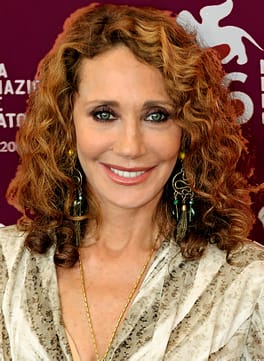
Photo: Nicogenin / CC BY-SA 2.0 (source: Wikimedia Commons)
My Take
Marisa Berenson is the rare figure who was genuinely iconic in two worlds. As a model she defined a moment, the kind of face Vogue built whole editorials around, and her Schiaparelli lineage gave her an effortless aristocratic glamour. But what fascinates me is how seriously she took acting: Visconti cast her in Death in Venice, and Kubrick chose her as the exquisitely sad Lady Lyndon in Barry Lyndon, where her stillness and porcelain beauty did half the storytelling without a word. Few supermodels of her era crossed into prestige cinema so convincingly. She embodies a vanished kind of 1970s European-American chic that's almost impossible to manufacture today.
This take was written by generative AI, one per person, from publicly reported facts (editorial policy). It is a reading of the record, not reporting.
Overview
Marisa Berenson (born February 15, 1947) is an American actress and fashion model. A celebrated fashion icon of the late 1960s and early 1970s who graced the covers of major magazines, she transitioned to acting in landmark films, notably Luchino Visconti's Death in Venice and Stanley Kubrick's Barry Lyndon, in which she played Lady Lyndon. She is a granddaughter of the fashion designer Elsa Schiaparelli.
1. Profile
- Name (English)
- Marisa Berenson
- Name (Japanese)
- マリサ・ベレンスン
- Reading
- まりさ・べれんすん
- Born
- February 15, 1947 (age 79)
- Occupation
- Actor / Model / Film actor / Television actor / Fashion model
- Zodiac / Chinese zodiac
- Aquarius / Pig
2. Links
- Official sitehttps://www.marisaberenson.com
- Instagramhttps://www.instagram.com/marisaberensonofficial/
- Wikipedia (English)https://en.wikipedia.org/wiki/Marisa%20Berenson
- Wikipedia (Japanese)https://ja.wikipedia.org/wiki/%E3%83%9E%E3%83%AA%E3%82%B5%E3%83%BB%E3%83%99%E3%83%AC%E3%83%B3%E3%82%BD%E3%83%B3
- Wikidatahttps://www.wikidata.org/wiki/Q285419
3. About this entry
Tags
- Last updated
Facts are limited to publicly available information up to 2024; non-public or unconfirmed items are omitted. English text is machine-assisted (facts translated by Sonnet, "My Take" written by Opus 4.8). The Japanese page is the source of record.
Frequently asked questions
When was Marisa Berenson born?
Born February 15, 1947 (age 79).
What does Marisa Berenson do?
Marisa Berenson works as Actor, Model, Film actor, Television actor, Fashion model.