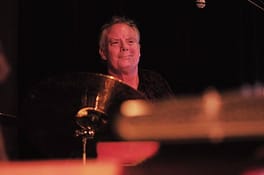
Photo: Joe Mabel on Flickr as Joe Mabel from Seattle, US / CC BY-SA 4.0 (source: Wikimedia Commons)
My Take
Michael Shrieve's drum solo during Santana's Soul Sacrifice at Woodstock is one of the great moments in rock film, and the fact that he was barely twenty makes it almost unbelievable. What I find compelling, though, is everything after: instead of coasting on that fame, he became a genuinely curious, restless musician, diving into jazz fusion, ambient, and electronic collaborations that most rock drummers wouldn't touch. He's a Rock and Roll Hall of Famer who never stopped experimenting. That combination of an iconic early peak and decades of fearless exploration makes him one of rock's most quietly interesting drummers.
This take was written by generative AI, one per person, from publicly reported facts (editorial policy). It is a reading of the record, not reporting.
Overview
Michael Shrieve (born July 6, 1949) is an American drummer, percussionist, and composer best known as the original drummer of Santana. He famously performed an extended drum solo during the band's set at the 1969 Woodstock festival while still a teenager. He has since worked extensively as a session musician and collaborator across rock, jazz, and electronic music, and is a Rock and Roll Hall of Fame inductee as a member of Santana.
1. Profile
- Name (English)
- Michael Shrieve
- Name (Japanese)
- マイケル・シュリーヴ
- Reading
- まいける・しゅりーゔ
- Born
- July 6, 1949 (age 77)
- Origin
- San Francisco, California, United States
- Occupation
- Composer / Percussionist / Musician
- Zodiac / Chinese zodiac
- Cancer / Ox
2. Background
- High school
- Junipero Serra High School (San Mateo, California)
3. Links
- Official sitehttp://www.michaelshrieve.com/
- Wikipedia (English)https://en.wikipedia.org/wiki/Michael%20Shrieve
- Wikipedia (Japanese)https://ja.wikipedia.org/wiki/%E3%83%9E%E3%82%A4%E3%82%B1%E3%83%AB%E3%83%BB%E3%82%B7%E3%83%A5%E3%83%AA%E3%83%BC%E3%83%B4
- Wikidatahttps://www.wikidata.org/wiki/Q1929406
4. About this entry
Tags
- Last updated
Facts are limited to publicly available information up to 2024; non-public or unconfirmed items are omitted. English text is machine-assisted (facts translated by Sonnet, "My Take" written by Opus 4.8). The Japanese page is the source of record.
Frequently asked questions
When was Michael Shrieve born?
Born July 6, 1949 (age 77).
Where is Michael Shrieve from?
Michael Shrieve is from San Francisco, California, United States.
What does Michael Shrieve do?
Michael Shrieve works as Composer, Percussionist, Musician.
Composer — see all → · Percussionist — see all → · More people from the United States →