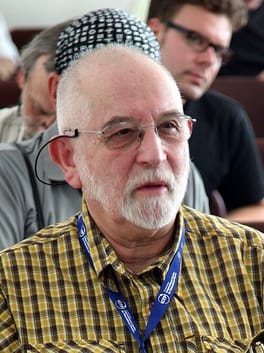
Photo: Vahram Mekhitarian derivative work: Jakob Gottfried / CC BY-SA 4.0 (source: Wikimedia Commons)
Born on March 14, 1941 in Surrey, United Kingdom, Michael Victor Berry is a mathematician, theoretical physicist and screenwriter. That puts Michael Victor Berry at 85 years old in 2026. Education on record includes Ilford County High School and University of St Andrews. Awards on record include Ig Nobel Prize (2000), Fellow of the Royal Society, Royal Medal (1990) and 5 more.
My Take
Sir Michael Berry is the rare scientist whose name became a thing physicists actually say daily: the Berry phase, plus the Berry connection and curvature. That alone would make him remarkable to me, but the detail I love is that his trophy case holds both the Wolf Prize in Physics and an Ig Nobel. Winning a serious top award and a tongue-in-cheek one signals a mind that takes the work seriously without taking itself too seriously. Bristol's emeritus professor strikes me as the kind of theorist who finds deep physics hiding in everyday phenomena, and clearly enjoys the hunt as much as the proof.
This take was written by generative AI, one per person, from publicly reported facts (editorial policy). It is a reading of the record, not reporting.
1. Profile
- Name (English)
- Michael Victor Berry
- Name (Japanese)
- マイケル・ベリー
- Reading
- まいける・べりー
- Born
- March 14, 1941 (age 85)
- Origin
- Surrey, United Kingdom
- Occupation
- mathematician / theoretical physicist / screenwriter / university teacher / physicist
- Zodiac / Chinese zodiac
- Pisces / Snake
2. Background
- High school
- Ilford County High School
- University
- University of St Andrews
Awards & achievements
- 2000 Ig Nobel Prize
- Fellow of the Royal Society
- 1990 Royal Medal
- 2014 Lorentz Medal
- 2005 Pólya Prize
- 1998 Wolf Prize in Physics
- 1990 IOP Dirac Medal
- 2002 Josiah Willard Gibbs Lectureship
3. Links
4. About this entry
Tags
- Last updated
Facts are limited to publicly available information up to 2024; non-public or unconfirmed items are omitted. English text is machine-assisted (facts translated by Sonnet, "My Take" written by Opus 4.8). The Japanese page is the source of record.
Frequently asked questions
When was Michael Victor Berry born?
Born March 14, 1941 (age 85).
Where is Michael Victor Berry from?
Michael Victor Berry is from Surrey, United Kingdom.
What does Michael Victor Berry do?
Michael Victor Berry works as mathematician, theoretical physicist, screenwriter, university teacher, physicist.
Mathematician — see all → · Theoretical physicist — see all → · More people from the United Kingdom →