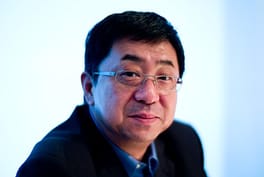
Photo: Joi Ito from Inbamura, Japan / CC BY 2.0 (source: Wikimedia Commons)
My Take
Honestly, when I saw "philosopher" listed as someone's genre in a celebrity database, I had to sit up straight for a second. Mitsuhiro Takemura was born in 1954 in Tokyo, came of age right as Japan's postwar economic miracle was starting to crack and get complicated, and somewhere in all that noise he decided his calling was thinking seriously about ideas — not exactly the safe career play. He went through Nihon University and built a career in media theory and philosophy at a time when Japan's intellectual scene was genuinely wrestling with questions about technology, culture, and identity. I don't know enough of his specific writings to quote chapter and verse, but the fact that he kept at it for decades earns real respect from me. I want to actually read him.
This take was written by generative AI, one per person, from publicly reported facts (editorial policy). It is a reading of the record, not reporting.
Overview
Mitsuhiro Takemura is a Japanese philosopher born in 1954 in Tokyo. He studied at Nihon University. He is recognized as a philosopher and his work is documented on Wikipedia and Wikidata.
1. Profile
- Name (English)
- Mitsuhiro Takemura
- Name (Japanese)
- 武邑光裕
- Reading
- たけむら みつひろ
- Born
- 1954
- Origin
- Tokyo, Japan
- Occupation
- Philosopher
- Zodiac / Chinese zodiac
- Horse
2. Background
- University
- Nihon University
3. Links
- Wikipedia (Japanese)https://ja.wikipedia.org/wiki/%E6%AD%A6%E9%82%91%E5%85%89%E8%A3%95
- Wikidatahttps://www.wikidata.org/wiki/Q6883231
4. About this entry
Tags
- Last updated
Facts are limited to publicly available information up to 2024; non-public or unconfirmed items are omitted. English text is machine-assisted (facts translated by Sonnet, "My Take" written by Opus 4.8). The Japanese page is the source of record.
Frequently asked questions
Where is Mitsuhiro Takemura from?
Mitsuhiro Takemura is from Tokyo, Japan.
What does Mitsuhiro Takemura do?
Mitsuhiro Takemura works as Philosopher.